
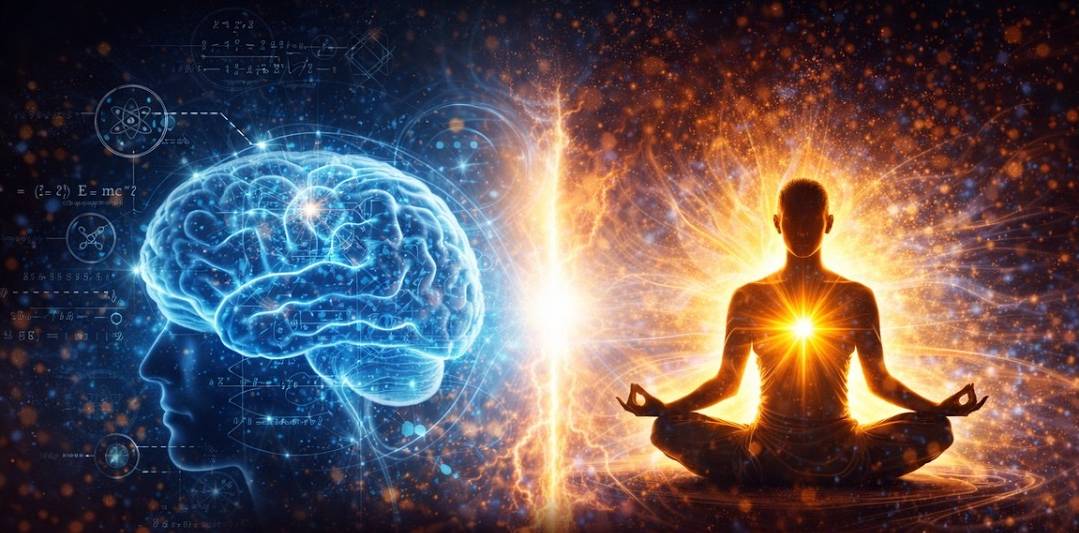
“When our minds are involved in matter, they think matter the only reality; when we draw back into immaterial consciousness, then we see matter a mask and feel existence in consciousness alone as having the touch of reality. Which then of these two is the truth? Nay, God knoweth; but he who has had both experiences, can easily tell which condition is the more fertile in knowledge, the mightier & more blissful.
I believe immaterial consciousness to be truer than material consciousness? Because I know in the first what in the second is hidden from me & also can command what the mind knows in matter.
Hell & Heaven exist only in the soul’s consciousness. Ay, but so does the earth and its lands & seas & fields & deserts & mountains & rivers. All world is nothing but arrangement of the Soul’s seeing.” (CWSA 12: 442)
I. The Subjective and the Objective Views of Reality and Knowledge
1. The Subjective View of Reality and Knowledge
In the subjective view of Reality the worlds are only frames of our experience, the senses only instruments of experience. “Consciousness is the great underlying fact, the universal witness for whom the world is a field, the senses instruments. To that witness the worlds and their objects appeal for their reality and for the one world or the many, for the physical equally with the supraphysical we have no other evidence that they exist. It has been argued that this is no relation peculiar to the constitution of humanity and its outlook upon an objective world, but the very nature of existence itself; all phenomenal existence consists of an observing consciousness and an active objectivity, and the Action cannot proceed without the Witness because the universe exists only in or for the consciousness that observes and has no independent reality. It has been argued in reply that the material universe enjoys an eternal self-existence: it was here before life and mind made their appearance: it will survive after they have disappeared and no longer trouble with their transient strivings and limited thoughts the eternal and inconscient rhythm of the suns.” (CWSA 21: 22-23) The difference, so metaphysical in appearance, is yet of the utmost practical import, for it determines the whole outlook of man upon life and raises the question of the reality of cosmic existence and the value of human life. But this question cannot be solved by logic based on the data of our ordinary physical existence with its limited consciousness and experience. Only by an extension of the field of our consciousness and an increase in our instruments of knowledge can this quarrel be resolved.
“The extension of our consciousness, to be satisfying, must necessarily be an inner enlargement from the individual into the cosmic existence. For the Witness, if he exists, is not the individual embodied mind born in the world, but that cosmic Consciousness embracing the universe and appearing as an immanent Intelligence in all its works to which either world subsists eternally and really as Its own active existence or else from which it is born and into which it disappears by an act of knowledge or by an act of conscious power. Not organised mind, but that which, calm and eternal, broods equally in the living earth and the living human body and to which mind and senses are dispensable instruments, is the Witness of cosmic existence and its Lord.” (CWSA 21: 24) To the man who has had contact with it or lives in it, the cosmic consciousness is real with a greater than the physical reality; real in itself, real in its effects and works. “And as it is thus real to the world which is its own total expression, so is the world real to it; but not as an independent existence. For in that higher and less hampered experience we perceive that consciousness and being are not different from each other, but all being is a supreme consciousness, all consciousness is self-existence, eternal in itself, real in its works and neither a dream nor an evolution. The world is real precisely because it exists only in consciousness; for it is a Conscious Energy one with Being that creates it. It is the existence of material form in its own right apart from the self-illumined energy which assumes the form, that would be a contradiction of the truth of things, a phantasmagoria, a nightmare, an impossible falsehood.” (CWSA 21: 25)
2. The Objective View of Reality & Knowledge
This view “affirms an objective Reality as the only entire truth and an objective knowledge as the sole entirely reliable knowledge. This view starts from the idea of physical existence as the one fundamental existence and the relegation of consciousness, mind, soul or spirit to the position of a temporary outcome of the physical Energy in its cosmic action, – if indeed soul or spirit has any existence. All that is not physical and objective has a lesser reality dependent on the physical and objective; it has to justify itself to the physical mind by objective evidence or a recognisable and verifiable relation to the truth of physical and external things before it can be given a passport of reality. But it is evident that this solution cannot be accepted in its rigour, as it has no integrality in it but looks at only one side of existence, even only one province or district of existence, and leaves all the rest unexplained, without inherent reality, without significance. If pushed to its extreme, it would give to a stone or a plum-pudding a greater reality and to thought, love, courage, genius, greatness, the human soul and mind facing an obscure and dangerous world and getting mastery over it an inferior dependent reality or even an unsubstantial and evanescent reality. For in this view these things so great to our subjective vision are valid only as the reactions of an objective material being to an objective material existence; they are valid only in so far as they deal with objective realities and make themselves effective upon them: the soul, if it exists, is only a circumstance of an objectively real world-Nature. But it could be held, on the contrary, that the objective assumes value only as it has a relation to the soul; it is a field, an occasion, a means for the soul’s progression in Time: the objective is created as a ground of manifestation for the subjective. The objective world is only an outward form of becoming of the Spirit; it is here a first form, a basis, but it is not the essential thing, the main truth of being. The subjective and objective are two necessary sides of the manifested Reality and of equal value, and in the range of the objective itself the supraphysical object of consciousness has as much right to acceptance as the physical objectivity; it cannot be a priori set aside as a subjective delusion or hallucination.
In fact, subjectivity and objectivity are not independent realities, they depend upon each other; they are the Being, through consciousness, looking at itself as subject on the object and the same Being offering itself to its own consciousness as object to the subject. The more partial view concedes no substantive reality to anything which exists only in the consciousness, or, to put it more accurately, to anything to which the inner consciousness or sense bears testimony but which the outer physical senses do not provide with a ground or do not substantiate. But the outer senses can bear a reliable evidence only when they refer their version of the object to the consciousness and that consciousness gives a significance to their report, adds to its externality its own internal intuitive interpretation and justifies it by a reasoned adherence; for the evidence of the senses is always by itself imperfect, not altogether reliable and certainly not final, because it is incomplete and constantly subject to error.
Indeed, we have no means of knowing the objective universe except by our subjective consciousness of which the physical senses themselves are instruments; as the world appears not only to that but in that, so it is to us. If we deny reality to the evidence of this universal witness for subjective or for supraphysical objectivities, there is no sufficient reason to concede reality to its evidence for physical objectivities; if the inner or the supraphysical objects of consciousness are unreal, the objective physical universe has also every chance of being unreal. In each case understanding, discrimination, verification are necessary; but the subjective and the supraphysical must have another method of verification than that which we apply successfully to the physical and external objective. Subjective experience cannot be referred to the evidence of the external senses; it has its own standards of seeing and its inner method of verification: so also supraphysical realities by their very nature cannot be referred to the judgment of the physical or sense mind except when they project themselves into the physical, and even then that judgment is often incompetent or subject to caution; they can only be verified by other senses and by a method of scrutiny and affirmation which is applicable to their own reality, their own nature.
There are different orders of reality; the objective and physical is only one order. It is convincing to the physical or externalising mind because it is directly obvious to the senses, while of the subjective and the supraphysical that mind has no means of knowledge except from fragmentary signs and data and inferences which are at every step liable to error. Our subjective movements and inner experiences are a domain of happenings as real as any outward physical happenings; but if the individual mind can know something of its own phenomena by direct experience, it is ignorant of what happens in the consciousness of others except by analogy with its own or such signs, data, inferences as its outward observation can give it. I am therefore inwardly real to myself, but the invisible life of others has only an indirect reality to me except in so far as it impinges on my own mind, life and senses. This is the limitation of the physical mind of man, and it creates in him a habit of believing entirely only in the physical and of doubting or challenging all that does not come into accord with his own experience or his own scope of understanding or square with his own standard or sum of established knowledge.
This ego-centric attitude has in recent times been elevated into a valid standard of knowledge; it has been implicitly or explicitly held as an axiom that all truth must be referred to the judgment of the personal mind, reason and experience of every man or else it must be verified or at any rate verifiable by a common or universal experience in order to be valid. But obviously this is a false standard of reality and of knowledge, since this means the sovereignty of the normal or average mind and its limited capacity and experience, the exclusion of what is supernormal or beyond the average intelligence. In its extreme, this claim of the individual to be the judge of everything is an egoistic illusion, a superstition of the physical mind, in the mass a gross and vulgar error. The truth behind it is that each man has to think for himself, know for himself according to his capacity, but his judgment can be valid only on condition that he is ready to learn and open always to a larger knowledge. It is reasoned that to depart from the physical standard and the principle of personal or universal verification will lead to gross delusions and the admission of unverified truth and subjective phantasy into the realm of knowledge. But error and delusion and the introduction of personality and one’s own subjectivity into the pursuit of knowledge are always present, and the physical or objective standards and methods do not exclude them. The probability of error is no reason for refusing to attempt discovery, and subjective discovery must be pursued by a subjective method of enquiry, observation and verification; research into the supraphysical must evolve, accept and test an appropriate means and methods other than those by which one examines the constituents of physical objects and the processes of Energy in material Nature.
To refuse to enquire upon any general ground preconceived and a priori is an obscurantism as prejudicial to the extension of knowledge as the religious obscurantism which opposed in Europe the extension of scientific discovery. The greatest inner discoveries, the experience of self-being, the cosmic consciousness, the inner calm of the liberated spirit, the direct effect of mind upon mind, the knowledge of things by consciousness in direct contact with other consciousness or with its objects, most spiritual experiences of any value, cannot be brought before the tribunal of the common mentality which has no experience of these things and takes its own absence or incapacity of experience as a proof of their invalidity or their non-existence. Physical truth of formulas, generalisations, discoveries founded upon physical observation can be so referred, but even there a training of capacity is needed before one can truly understand and judge; it is not every untrained mind that can follow the mathematics of relativity or other difficult scientific truths or judge of the validity either of their result or their process. All reality, all experience must indeed, to be held as true, be capable of verification by a same or similar experience; so, in fact, all men can have a spiritual experience and can follow it out and verify it in themselves, but only when they have acquired the capacity or can follow the inner methods by which that experience and verification are made possible. It is necessary to dwell for a moment on these obvious and elementary truths because the opposite ideas have been sovereign in a recent period of human mentality, – they are now only receding, – and have stood in the way of the development of a vast domain of possible knowledge. It is of supreme importance for the human spirit to be free to sound the depths of inner or subliminal reality, of spiritual and of what is still superconscient reality, and not to immure itself in the physical mind and its narrow domain of objective external solidities; for in that way alone can there come liberation from the Ignorance in which our mentality dwells and a release into a complete consciousness, a true and integral self-realisation and self-knowledge.” (CWSA 22: 673-77)
“The knowledge of the Sthula is science. The knowledge of the Sukshma is philosophy, religion and metaphysics. The knowledge of the Karana is Yoga. When a man knows the Sthula, he knows it with his senses, that is, with the Manas, he knows the Sukshma with reason or the inspired intellect, he knows the Karana with the Jnanam or spiritual realisation. Therefore complete knowledge consists of three operations, first, objective Upalabdhi or experience, secondly, intellectual statement of your understanding of the thing, thirdly, subjective Upalabdhi or spiritual experience. The scientist begins from the bottom and climbs if he can, to the top. The Yogin begins from the top and descends for perfect proof to the bottom.” (CWSA 11: 1379-80)
3. The Integral Spiritual View of Reality and Knowledge
“In the integral spiritual view of existence, “The world is a movement of God in His own being; we are the centres and knots of divine consciousness which sum up and support the processes of His movement. The world is His play with His own self-conscious delight, He who alone exists, infinite, free and perfect; we are the self-multiplications of that conscious delight, thrown out into being to be His playmates. The world is a formula, a rhythm, a symbol-system expressing God to Himself in His own consciousness, – it has no material existence but exists only in His consciousness and self-expression; we, like God, are in our inward being That which is expressed, but in our outward being terms of that formula, notes of that rhythm, symbols of that system. Let us lead forward God’s movement, play out His play, work out His formula, execute His harmony, express Him through ourselves in His system. This is our joy and our self-fulfillment; to this end we who transcend and exceed the universe, have entered into universe-existence.
Perfection has to be worked out, harmony has to be accomplished. Imperfection, limitation, death, grief, ignorance, matter, are only the first terms of the formula – unintelligible till we have worked out the wider terms and reinterpreted the formulary; they are the initial discords of the musician’s tuning. Out of imperfection we have to construct perfection, out of limitation to discover infinity, out of death to find immortality, out of grief to recover divine bliss, out of ignorance to rescue divine self-knowledge, out of matter to reveal Spirit. To work out this end for ourselves and for humanity is the object of our Yogic practice.” (CWSA 12: 97)
Not only Yoga but Science too seeks knowledge, perfection and fulfillment in its own way of perceiving and pursuing them which is exactly the opposite of the Yogic or the spiritual way of doing things. The spiritual works from within outwards and makes the outer the result of the inner. The materialistic science makes the inner the result of the outer, fundamentally a phenomenon of Matter and it works upon that view of things. With this limitation in its approach to knowledge, it cannot arrive at true knowledge or perfection and can never lead to fulfillment. This is not to deny that the preoccupation with life and matter at the beginning is both right and necessary for man because the first step he has to take in his journey is to know and possess the physical existence as well as he can by applying his thought and intelligence to such experience of it as his sense-mind can give him. But this is only a preliminary step and, if we stop here, we would have made no real progress.
Science has sought to ‘perfect’ humanity by outward means and one of its main effort has been to construct a powerful social machine which will train and oblige men to be what they ought to be. Looking at the results obtained by the modern socio-economic systems (socialistic or capitalistic) inspired by this approach of science; it is clear that these systems have, as expected, utterly failed to bring about any real change in the condition of humanity. But, in spite of this failure, this approach of materialistic science still continues to dominate and guide the thinking of humanity at large. If one looks a little deeply for the reason behind such a state of things, one finds it in the almost universal and complete subjection of humanity to a surface separative consciousness which is the basis of the universal blinding force designated as Ignorance in Indian philosophy.
The task of religion and spirituality is to mediate between God and man, between the Infinite and this finite, between a luminous Truth-Consciousness and the Ignorance. Considering the results obtained so far, it has certainly been the most arduous and difficult of all the tasks – even for a system of religious and spiritual seeking as wide, deep and supple as the one prevailing in India (called Sanatana Dharma) – because nothing is more difficult than to bring home the greatness and uplifting power of the spiritual consciousness to the natural man forming the vast majority of the human race; for his mind and senses are turned tenaciously outward towards the external calls of life and its objects and never inwards to the Truth which lies behind them. Our life moves between the two worlds, the depth upon depth of our inner being – the domain of occultism and spirituality – and the surface field of our outer nature – the domain of rational science. In between lie the things of the mind such as aesthetic and ethical culture which the West persistently mistakes for spirituality. The spiritual knowledge perceives that there is a greater thing in us; our inmost self, our real being is the divinity within, the Spirit, and these outer things of the mind are only its instruments. Therefore, the first object of all spiritual seeking is to discover our deepest being and hidden spiritual nature. The spirit and the way of approach necessary for such a discovery is bound to be entirely different from that of the material science.
II. Science and Spirituality: Methods and Approaches
1. The Method of Science
“The dharma of science, thought and philosophy is to seek for truth by the intellect dispassionately, without prepossession and prejudgment, with no other first propositions than the law of thought and observation itself imposes.” (CWSA 25: 229)
Science is concerned with a systematic study of the physical and natural world through observation and experiment based on human reason. It searches for measurable elements among natural phenomenon and then searches for relations between these measures of physical quantities. And since science is based on reason which starts from ignorance and moves in a great environing circle of ignorance, it must proceed by hypothesis, assumption and theory subject to verification of some kind convincing to our reason and experience.
The method of science consists of three steps: (1) Objective observation, (2) Deduction and theory and (3) Verification and modification (of the theory). Objective observation is important for arriving at a good theory – a theory which will describe a large range of phenomena on the basis of a few simple postulates and will make definite predictions that can be tested. If the predictions agree with objective observations, the theory survives the test, but no matter how many observations are consistent with the theory, it can never be proved to be correct. On the other hand, if a single observation disagrees with it, one has to discard or modify the theory. But this is so only in the case of physical sciences. In the case of medical or psychological sciences, for example, a single negative example need not throw out or disprove the whole theory.
Thus the method of physical science consists in scrutanising, experimenting, testing and holding nothing for established which cannot be spontaneously and universally verified. It is not merely by reason but by repetition of experience coupled with an element of intuition that a scientist distinguishes between a right and a wrong theory. A great problem with the method of science is that there may be any number of conflicting theories – some apparent and the others not apparent to the observer – which may be consistent with the data and in such a case it is not possible to objectively choose between these. In any case, a subjective element – the personal preference of the observer – inevitably enters.
Traditionally, physical science has tried to assume objectivity by limiting observation to measurable elements among the natural phenomena. But the Quantum Theory has changed the classical view of science considerably by revealing the crucial role of the observer’s consciousness in the process of observation and thus invalidating the (always superficial) idea of an objective description of nature. In quantum physics when one wishes to observe the smallest particles of matter, the process of observation affects the particles observed, thus leading to the loss of objectivity in observation. It is beginning to be realized by an increasing number of scientists that all knowledge and experience are subjective at bottom. Objective (so called) external physical things are seen very much in the same way by human beings because of the construction of the mind and senses; with another construction of mind and sense quite another account would be given of the physical world. Science itself has come to clearly understand, accept and realize that the observed patterns of matter are nothing but the reflections of the patterns of human mind. Since, as discussed earlier, the subjective and the objective are only two sides of the same thing, it will not do to insist on ascribing reality exclusively to either of these. The latest trend in science is to accept subjectivity as an unavoidable fact of life. Since objectivity is the heart of scientific method distinguishing it from the spiritual, rather than compromising on objectivity, this has led science to push objectivity one level higher and from there to observe one’s subjective interaction with the universe. Thus one is called upon to simultaneously maintain both the subjective and objective poises. Even in the exploration of the supraphysical, the scientific spirit requires one to maintain this dual pose in order to ascertain the validity of subjective experience.
The scientific method depends critically on the accuracy of observation which, given the inevitable element of subjectivity, is difficult enough to ensure beyond a point; but even more serious is the difficulty of getting all the facts complete without which the deduction cannot be expected to be correct. Science is limited to the experience and scrutiny of the physical nature alone. It cannot take into account the supraphysical forces which are the real determinants of events here. So it is impossible for science to take account of all the factors. Actually, given the nature of the human mind, it cannot be expected to take into account even all the physical factors. A scientist looks at events in terms of cause and effect and what it considers the cause of a particular effect may only be the immediate but not its deeper cause. For an effect to be produced many forces have to come into play; even the opposing forces are necessary to balance and bring about the effect. The human mind sees only some of these factors, and that too only partially, and misses the rest. The nature of the human mind is such that it cannot look at things as a whole, it sees only by parts. It is like switching on a light and thinking that the switching must be the cause of light. But the one who has the knowledge of electric systems knows a little more and is aware of the fact that many things have to work out before the light can be produced by switching.
“…the great stumbling block that has stood in the way of Science is its inability to get inside its object, the necessity under which it labours of building on inferences from external study, — & all its desperate & cruel attempts to make up the deficiency by vivisection or other ruthless experiments cannot remedy the defect. Yoga enables us to get inside the object by dissolving the artificial barriers of the bodily experience & the mental ego-sense in the observer. It takes us out of the little hold of personal experience and casts us into the great universal currents; takes us out of the personal mind sheath & makes [us]one with universal self and universal mind.” (CWSA 22: 131)
2. The Method of Spirituality
“In moments when the inner lamps are lit
And the life’s cherished guests are left outside,
Our spirit sits alone and speaks to its gulfs.
A wider consciousness opens then its doors;
Invading from spiritual silences
A ray of the timeless Glory stoops awhile
To commune with our seized illumined clay
And leaves its huge white stamp upon our lives.
In the oblivious field of mortal mind,
Revealed to the closed prophet eyes of trance
Or in some deep internal solitude
Witnessed by a strange immaterial sense,
The signals of eternity appear.
The truth mind could not know unveils its face,
We hear what mortal ears have never heard,
We feel what earthly sense has never felt,
We love what common hearts repel and dread...” (CWSA 33: 47-48)
“An inspired Knowledge sat enthroned within
Whose seconds illumined more than reason’s years...” (CWSA 33: 37)
The method of Yoga in knowledge must always be a turning of the eye inward and, so far as it looks upon outer things, a penetrating of the surface appearances to get at the one eternal reality within them. The lower knowledge is preoccupied with the appearances and workings; it is the first necessity of the higher to get away from them to the Reality of which they are the appearances and the Being and Power of conscious existence of which they are the workings. It does this by three movements each necessary to each other, by each of which the others become complete, – purification, concentration, identification.
The object of purification is to make the whole mental being a clear mirror in which the divine reality can be reflected, a clear vessel and an unobstructing channel into which the divine presence and through which the divine influence can be poured, a subtilised stuff which the divine nature can take possession of, new-shape and use to divine issues. For the mental being at present reflects only the confusions created by the mental and physical view of the world, is a channel only for the disorders of the ignorant lower nature and full of obstructions and impurities which prevent the higher from acting; therefore the whole shape of our being is deformed and imperfect, indocile to the highest influences and turned in its action to ignorant and inferior utilities. It reflects even the world falsely; it is incapable of reflecting the Divine.
Concentration is necessary, first, to turn the whole will and mind from the discursive divagation natural to them, following a dispersed movement of the thoughts, running after many-branching desires, led away in the track of the senses and the outward mental response to phenomena: we have to fix the will and the thought on the eternal and real behind all, and this demands an immense effort, a one-pointed concentration. Secondly, it is necessary in order to break down the veil which is erected by our ordinary mentality between ourselves and the truth; for outer knowledge can be picked up by the way, by ordinary attention and reception, but the inner, hidden and higher truth can only be seized by an absolute concentration of the mind on its object, an absolute concentration of the will to attain it and, once attained, to hold it habitually and securely unite oneself with it. For identification is the condition of complete knowledge and possession; it is the intense result of a habitual purified reflecting of the reality and an entire concentration on it; and it is necessary in order to break down entirely that division and separation of ourselves from the divine being and the eternal reality which is the normal condition of our unregenerated ignorant mentality.
3. A Contrast: Science Versus Spirituality
The method of materialistic science is just the opposite of the spiritual way of doing things. The spiritual works from within outwards, the way of science is to work from outwards and make the inner a result of the outer. This basic difference in the outlook and approach can be seen manifesting in varying shades and colours in the attitudes and doings of scientists and Yogis. Here we shall have a look at some of the most important ones.
A. The Perception of the Physical Phenomena and Dealings with Them
“Scientific method gives us knowledge only of the physical part of the universe and even here it gives knowledge only of a part – the quantitative part. But, there is not merely the quantitative law or knowledge, there is also a qualitative law – the province of subjective methods – which is much more important than the quantitative law. The subjective disciplines – spirituality, occultism, etc. – deal with subtle planes behind the physical, the knowledge of the forces of these planes and the way of mastering them.
The main concern of the scientist is with physical phenomena. He observes them, studies the conditions and makes experiments and then deduces the laws. In Yoga or spirituality, instead, one has to find out the right Dharma, the right way of functioning, of movement of forces. “Not merely the law which is mechanical, but the Dharma of the movement of forces. An ordinary law merely means an equilibrium established by Nature; it means a balance of forces. It is merely a groove in which Nature is accustomed to work in order to produce certain results. But, if you change the consciousness, then the groove also is bound to change. For instance, I observe the forces on the vital plane, I see what they are, and what they intend. If they are hostile they attack me. Then I have to find out how they shall not attack me.
I put forth some force and see how they react; I have also to see how they would react if I put forth the force in a different way.
Even in knowing physical phenomena, the Yogi’s way of knowing is different from that of the scientist. For instance, when I light a match I do not know the chemical composition of the match, and how it burns when struck. But I feel and know beforehand whether it will light or not, or whether it will do the work intended of it, and that is enough for me. I know it because I am in contact with the force that is in it, the Sat and the Chit in movement there.
The Yogi’s way of dealing with these physical forces is also different from that of the scientist. Take, for instance, the fire that broke out in Tokyo. What the scientist would do is to multiply means and organise devices to prevent and put out the fire. What the Yogi would do in the same case is that he would feel the Spirit of fire approaching and, putting forth his force, he would be able to prevent the fire from breaking out in his vicinity.
These dealings are with quite different orders of facts.” (Evening Talks by A. B. Purani: 75-76)
When it comes to the perception of motives behind physical acts, especially when related to persons living in deeper consciousness, there is a world of difference between the perception of a Yogi and a person living in ordinary physical consciousness. A glaring example of this we find in a letter of Yogi Sri Krishanprem written in 1931 to Sri D. K. Roy. Here is the relevant excerpt from this letter. “A learned article I read the other day in the Orient described Sri Chaitanya Mahaprabhu as ‘plunging into the ocean maddened to ecstasy by its beauty.’ Hai! Hai! (alas!) and I suppose it was the beauty of the muddy puddle of rain-water on the site where now stands Radhakunda that led Sri Chaitanya Deva to do the same there? The majesty of the ocean may be a great thing, but it was not that which had intoxicated Sri Gauranga, but the infinitely more maddening sense-destroying beauty of Sri Krishna whom he saw standing in front of him.
Gone were the ocean-waves, and in their place he saw only the blue rippling waters of the Jumna surrounding the blue smiling figure of his Lord and it was that sight that annihilated his senses and made him plunge madly in, careless of all but of reaching his Beloved. But I suppose that is all effete superstition?” (Yogi Sri Krishnaprem by D. K. Roy: 145)
B. The Device and the Reality Behind
The important question here is whether it is the reality behind that adopts the device to suit its purpose or it is the device that determines the result?
“All things on the physical plane are merely devices – they are a system of notation, – just like the wireless or telegraphic notation. It is a convenient device for sending messages, but often we get too busy with the device and mistake it for the thing that is behind the device.
And this applies to all scientific discoveries. For instance, when you say ‘hydrogen and oxygen in certain proportions form water’, the statement does not explain anything. It only states a fact. You do not know what water is. It only means there is something behind which manifests itself as water under those conditions.
It is the same with the theory of ‘electrons’. So far as the physical facts are concerned the theory may be perfectly true. But why should the blessed electrons, which are fundamentally the same substance, form totally different elements and compounds by the change of arrangement of the same number?
Disciple: Not only that, but the addition or subtraction of one electron changes radically the properties – that is, the nature – of the substance. And even with the same number of electrons a change in the arrangement alters radically the substance. So much so that one substance is a poison and the other is not.
Sri Aurobindo: So I say there is something behind the device which already pre-exists on some plane and it is that which adopts the device in order to manifest itself. But the device is not the reality. The power from behind can change the device. Of course, the power working from behind comes down on the physical plane through the device, and so people generally think that it is the device which is responsible for the manifestation.
As an instance of the change of device I told you about Agamya Guru Paramahamsa. He could stop his heart-beats and go on talking and working like other men. Now, ordinarily, when the heart stops the man dies, or gets into a catalyptic Samadhi. But in his case it was not so.” (Evening Talks by A. B. Purani: 171-72)
“Indifferent to doubt and to belief,
Avid of the naked real’s single shock
He shore the cord of mind that ties the earth-heart
And cast away the yoke of Matter’s law.
The body’s rules bound not the spirit’s powers:
When life had stopped its beats, death broke not in;
He dared to live when breath and thought were still.
Thus could he step into that magic place
Which few can even glimpse with hurried glance
Lifted for a moment from mind’s laboured works
And the poverty of Nature’s earthly sight.” (CWSA 33: 74)
“All the exercises, like breathing-practices, are only devices which something that is behind them is using for manifesting itself.
On the physical plane also, it is nothing else but certain devices – a system of notation – that we employ. But we give too much importance to the form of the device, because we think the physical to be the most real. If we only knew that the entire physical world is made up of force and that it is nothing else but the working of a certain consciousness and power using certain devices then we would not be deceived.” (Evening Talks by A. B. Purani: 169)
C. The Process by which Things Happen and the Reason for which They Happen
“The significance of the lotus is not to be found by analyzing the secrets of the mud from which it grows here; its secret is to be found in the heavenly archetype of the lotus that blooms for ever in the Light above.” (CWSA 31: 616)
Another way of looking at the issue discussed above is to take note of the almost universal tendency among the scientists to believe that when the process by which a thing happens has been explained, the reason for which it happens has also been explained. Here we reproduce relevant excerpts from two letters of Yogi Sri Krishnaprem and Sri Aurobindo to Sri D.K. Roy for a detailed and in-depth discussion of this issue.
“You ask me to explain why I think that modern analytic psychology and subjectivist physics are going to be a more effective veil to Reality than the old Materialism. Well, I can’t give proof – but can only make a few suggestions. Religious apologists made a great mistake in abandoning their defences and retreating to a supposedly impregnable ‘Hindenburg Line’ of subjective experiences. They relegated the truth of religion to the reign of the inner self, then largely unexplored, just as the Theosophists located their Mahatmas in unexplored Tibet. And they bolstered up their position with all sorts of pragmatic arguments such as that prayer was a reality because of the peace it brought etc. Now this was cowardly and therefore foolish…. Nayamatma balahinena labhyah…. Baffled for the moment, the attackers… then set to work to study the nature of the fortress in which the apologists had so unwisely shut themselves up. They have now developed and are still developing a technique which enables them to account so plausibly for subjective psychic or mystic experiences that most superficial thinkers are convinced.
First, the work of anthropologists of the Frazer school collected a mass of information about savage magico-religious rites (which they understood only in an exterior manner – compare, for instance, Sea-brook’s inside account of African Negro magic with the account given by any orthodox anthropologist) and then it was easy to show that the same primitive (and therefore presumably ridiculous) ideas persisted in modern religions.
And then the subjective experiences. Experiments with drugs showed that to some extent similar states (to the mystic’s experiences) can be produced in the laboratory. Other experiences are dealt with in the manner satirized in one of G. K. Chesterton’s fantasies: A man shipwrecked from his yacht found himself in the compound of a lunatic asylum and was promptly assumed to be a patient. Every explanation he tried to give of his arrival was assumed to be delusion about shipwreck. Thus, if the mystic escapes the Scylla of Freudian repressed sensuality, he is caught in the Charybdis of Jung’s ‘racial unconscious’ in which, for some reason, all the religious symbols of the past are supposed to be preserved like flies in amber and to issue unexpectedly, causing the appearance of mystic experience.
But I must come to the point. There is a saying in Vishva-Sara Tantra; “What is there is here, what is not here is nowhere”: yadihasti tadamutra yannehasti na tat kvachit – If God exists in the subjective world then he exists equally in the objective world. But the objective side has generally been abandoned by the defenders. If the working of the mind in mystic experiences is explained as has been the working of Nature, then the ordinary educated man will feel that the last stronghold is gone and that all farther belief is impossible. And it will be so explained away. This is quite certain. Why? Because the mind, as you know, is just as much mechanical (and as little if you like) as the outer world. It is merely more subtle: sukshmah: both are mere modifications of prakriti and explicable in similar ways. The real subject (and object, too) is the jivatma (soul) and that is for ever beyond the ken of mechanistic science because it is in a different dimension. (I use dimension only metaphorically). Now the modifications of prakriti form a closed circle as it were, Guna guneshu vartante, as the Gita says. Science moves in the sphere of phenomena, that is, of the gunas, and there will always be an apparent causal sequence among all phenomena in the plane of phenomena and there is small reason to suppose that the end will ever come and, even if it did, it would be back at the beginning again – the snake with its tail in the mouth. In time, science will no doubt come to admit certain apparently marvellous phenomena now denied, but they will be found also to be explicable along similar lines to all other natural phenomena. All phenomena can be explained in two ways: one in their own plane, and the other at right angles to it as it were, that is, in a different dimension. In their own plane all phenomena follow mechanical laws. This is the mechanism by which they take place (for, after all, everything, however ‘marvellous’ has to take place in some definite way) and this mechanism is in the realm of science. The other explains the reason for which they happen and this is the sphere of the mystic or Yogi. This possibility of two-fold explanation applies, I believe, to all phenomena whether ‘physical’ or ‘mental’ or ‘psychic’. (I use ‘psychic’ here in its ordinary meaning – somewhat different from that which it bears in Sri Aurobindo’s system, I believe). But when an explanation has been given along the lines of the first method there is an almost universal tendency to think that the phenomena in question have been completely explained – not to say explained away. Hence my forecast of a thickening of the veil, for it is the second method alone which brings the seeker through other planes into the region of real causation and of the Ultimate Reality. And this method requires an act of faith at the outset and an attitude of mind throughout that is quite different from that of most scientists.
I have said nothing so far about the modern tendencies in physics. The subjectivism of Jeans, Eddington and others is no doubt nearer the truth than the nineteenth century conceptions. But the crucial point is not whether the universe is composed of miniature billiard-balls vibrating in an elastic jelly or of geodesics in an expanding soap-bubble of space-time, but whether its basis is to be found in Sachchidananda or merely in a tenuously incomprehensible but ultimately dead square-root of minus one; and on this point physics, however subjective, can give no answer.
One last word and I have done. I think you will find in what I have said above concerning the two-fold explanation of phenomena the meaning of certain apparent paradoxes in the Gita. For instance, you will find there two sorts of statements about the way in which things happen:
Na kartritvam no karmani lokasya srijati Prabhuh
Na karmaphala-samyogam svabhavas-tu pravartate.
That is:
The Lord produces neither agency nor actions nor yet the union of action and fruit. All is a manifestation of Nature.
And then, on the other hand:
Isvarah sarvabhutanam hriddeshe’rjuna tishthati
Bhramayan sarvabhutani yantrarudhani mayaya.
That is:
O Arjuna! the Lord, seated in the hearts of all, whirls around by His maya all beings as if they were mounted on a machine.
The first couplet refers to the first type of explanation in which Sri Krishna plays no part, being outside the series; the last to the second type in which He plays the only part. Tameva sharanam gaccha, O Dilip! (Take refuge in Him alone).” (Yogi Sri Krishnaprem by D. K. Roy: 147-50)
On this letter Sri Aurobindo commented: “It was a great refreshment to read the letters of Krishnaprem; one feels here a stream from the direct sources of Truth that one does not meet so often as one could desire. Here is a mind that can not only think but see – and not merely see the surfaces of things with which most intellectual thought goes on wrestling without end or definite issue and as if there were nothing else, but look into the core. The Tantriks have a phrase Pashyanti Vak to describe one level of the vak-shakti, the seeing Word. Krishnaprem has, it seems to me, much of the Pashyanti Buddhi, the seeing Intelligence…. A distinction, the distinction very keenly made here, between the plane of phenomenal process, of externalized Prakriti, and the plane of Divine Reality ranks among the first words of the inner wisdom. The turn Krishnaprem gives to it is not merely an ingenious explanation, it expresses very soundly one of the clear certainties you meet when you step across the border and look at the outer world from the standing-ground of the inner spiritual experience. The more you go inward or upward, the more the view of things changes and the outer knowledge science organises takes its real and very limited place. Science, like most mental and external knowledge, gives you only truth of process. I would add that it cannot give you even the whole truth of process; for you seize some of the ponderables, but miss the all-important imponderables; you get, hardly even the how, but the conditions under which things happen in Nature. After all the triumphs and marvels of Science, the explaining principle, the rationale, the significance of the whole is left as dark, as mysterious and even more mysterious than ever. The scheme it has built up of the evolution not only of this rich and vast variegated material world, but of life and consciousness and mind and their workings out of a brute mass of electrons, identical and varied only in arrangement and number, is an irrational magic more baffling than any the most mystic imagination could conceive. Science in the end lands us in a paradox effectuated, an organised and rigidly determined accident, an impossibility that has somehow happened, – it has shown us a new, a material Maya, aghatana-ghatana-patiyasi, very clever at bringing about the impossible, a miracle that cannot logically be and yet somehow is there – actual, irresistibly organised, but still irrational and inexplicable. And this is evidently because science has missed something essential: it has seen and scrutinised what has happened and, in a way, how it has happened, but it has shut its eyes to something that made this impossible possible, something it is there to express. There is no fundamental significance in things if you miss the Divine Reality; for you remain embedded in a huge surface crust of manageable and utilisable appearance. It is the magic of the Magician you are trying to analyse, but only when you enter into the consciousness of the Magician himself can you begin to experience the true origination, significance and circles of the Lila. I say ‘begin’ because, as you suggest, the Divine Reality is not so simple that at the first touch you can know all of it or put it into a single formula; it is Infinite and opens before you an infinite knowledge to which all science put together is a bagatelle. But still you do touch the essential, the eternal behind things and in the light of That all begins to be profoundly luminous, intimately intelligible.” (Yogi Sri Krishnaprem by D. K. Roy: 150-54)
III. The Nature of the Supreme Reality: Scientific Versus the Spiritual Way of Approach
1. The Scientific Way of Approach
The scientific method of knowledge is to “…induce Nature and Being to reveal their own way of being and proceeding, not hastening to put upon them our own impositions of idea and imagination…” (CWSA 13: 195) While suppressed earlier by the ages of Philosophy and Religion during the medieval era in Europe, Science reached its full flowering with the rise of the individualistic age of mankind in the 18th and 19th centuries.
The attempt to govern and organise human life by verifiable Science, by a law, a truth of things, an order and principles which all can observe and verify has been the culminating movement of European civilisation which is being progressively subscribed to by humanity at large. However, Science’s quest to foreground a unifying theory – a theory of everything – to explain the universe as being constituted by fundamental particles of matter has been thwarted by conflicting findings time and again. Many of the most profound and far-reaching scientific hypotheses of the last century in the field of the structure of the cosmos have not been borne out by the latest findings using the Large Hadron Collider near Geneva.
A. Physicists – The Modern Myth-Makers
“In 1900 physicists were feeling pretty smug. Many of them thought they had the universe taped. The majestic clockwork wound up by Isaac Newton was running exactly as predicted. Subsequent discoveries in fields as diverse as heat, light and electricity all seemed to fit into the grand scheme of things. New telescopes were mapping the heavens and revealing that the earth and its sun were part of a huge but measurable star system, the Milky Way, that seemed to encompass the whole universe. Exactly what an atom was remained to be determined, and there were a few puzzling discoveries, such as cathode rays and radioactivity. But these could surely be fitted in. Basically, it was just a matter of dotting the ‘i’s and crossing the ‘t’s.
A few years later, it was all over. People realised that far from knowing everything, they knew almost nothing. Two hypotheses, quantum theory and relativity, and two discoveries, the atomic nucleus and the fact that the Milky Way was not alone, but was one of a zillion similar galaxies, did not merely upset the apple cart, they scattered its contents right over the road. It has taken a century to pick the apples up and order them neatly again.
The result is impressive. Quantum theory, first proposed by Max Planck in 1900, has been elaborated into a comprehensive description of the very small. It is riddled with weirdness, mostly the result of Werner Heisenberg’s famous uncertainty principle (namely, that it is impossible to be sure, at the same time, where an object is and how fast it is travelling). But it provides an accurate description of the way things are, down to the smallest objects that machines can measure. At the other end of the scale, Albert Einstein’s theories of relativity (the special theory, proposed in 1905, and the general theory, proposed in 1916), describe the way things are up to the largest objects that machines can measure.
Using these theories and those machines, physicists have discovered many of the fundamental particles of which the universe is made, the forces that hold them together, and how those particles and forces interact to produce a bestiary of other objects – atomic nuclei and galaxies included – that were unknown in 1900. A coherent picture of sub-atomic physics, known as the Standard Model, has been painstakingly put together, and almost all the observations seem to fit into it. Similarly a coherent picture of the universe, known as the Big Bang cosmology, has emerged. Again, almost all the observations seem to fit.
This time, though, no one is feeling smug. For one thing, good as quantum theory and relativity are at explaining things, neither can be explained in terms of the other. Like parallel lines, they never meet. Nor, even in its own terms, is either of them a ‘theory of everything’. At one level, both explain the universe very well indeed. At another, they explain nothing – for although they give a good description of the way things are, they are silent about why they are that way.
Moreover, there is that weasel phrase ‘almost all the observations seem to fit’. As with cathode rays and radioactivity a century ago, some false notes are emerging. And there are a few dissenters, especially on the cosmological side, who doubt that some of the observations are actually good enough to support the theories built on them. With luck, new machines that are now coming into service, or will do so soon, will be able to address these problems. These machines will gather more and better data to quell the dissidents (or maybe prove them right) and to help to decide between the competing theories which try to embrace those observations that do not currently fit.
The next decade or so is likely to be a battleground between those theories. There are many ideas around, some extremely strange by everyday standards, and not all of them easily testable. What these ideas represent is the latest chapter in the construction of a modern creation-myth. For, unlike most branches of science, fundamental physics – the study of the very small and the very large – is not undertaken in the hope of tangible benefit. It is done to answer the question ‘Why?’ In some ways, therefore, it resembles a branch of theology.
Like the theologies of earlier days it demands huge temples for its worship. These temples are not cathedrals and mosques, but telescopes and particle accelerators. Their guardians – the successors of Newton, Planck, Einstein and myriad others, less famous in the wider world – are sometimes, jokingly, referred to as the priests of science. But the joke has a hard edge to it. In some senses they do have a priestly role. For they are the creators of the real story of creation: the modern myth-makers.” (The Economist, January 5-11, 2002: 47-48)
B. The Curve of Scientific Progress
The modern age of science has yielded us path breaking theories to explain the universe. However brilliant and satisfactory their explanation of the universe has been – and it has been undoubtedly so – their unsolved riddles and mutual contradictions have become overpowering – so much so that they have brought the progress of Science in the area of fundamental physics to an unexpected halt. Writing in the second decade of the last century Sri Aurobindo had the perception of such a turn in the future when he wrote, “We shall perceive that until the possibilities of mind and spirit are better explored and their truths better known, we cannot yet pronounce the last all-ensphering formula of universal existence. Very early in this process the materialistic circle will be seen opening up on all its sides until it rapidly breaks up and disappears.” (CWSA 13: 195)
In the past few centuries physics has transformed both daily life and world history with novelties ranging from electricity to nuclear bombs. Physicists have also broadened humanity’s horizons, literally and metaphorically. Time and again, they have overturned notions of reality previously held – often by the self-same physicists – to be fundamental. They could be about to do so once more.
On a cosmic scale, a universe that was once thought to be a few thousand years old, and to consist of a handful of orbs circling Earth against a fixed backdrop of stars, has been shown to have an age of 13.77bn years – a value believed to be known to within a precision of three parts in a thousand. That universe may also be infinite in size. Certainly it stretches at least as far as the distance that light can have travelled in the period since its birth, for what can be seen of it with telescopes has no boundary.
Physics has also revealed what everything is made of, up to a point. It has turned the atom, once a figment of philosophy, into a quotidian object to be trapped, observed, put to work and split – sometimes to produce energy, sometimes to produce knowledge. It has now assembled a plausible catalogue of the components of these atoms and of the components of some of those components, together with a list of the forces that hold everything together. But progress in this area has come to an unexpected halt.
Physicists have got used to the idea that mathematical theories can be turned into reliable representations of reality, thus producing understanding. And one discovery based on maths that physicists were pretty confident of making was of a phenomenon called Supersymmetry, which gives coherence to the current, rather ad hoc explanation of the menagerie of fundamental particles that has been collected since the 1890s. Supersymmetry is a stalking horse for a yet-deeper idea, string theory, which posits that everything is ultimately made of infinitesimally small objects that are most easily conceptualised by those without the maths to understand them properly as taut, vibrating strings.
So sure were most physicists that these ideas would turn out to be true that they were prepared to move hubristically forward with their theorising without experimental backup – because, for the first decades of Supersymmetry’s existence, no machine powerful enough to test its predictions existed. But now, in the form of the Large Hadron Collider, near Geneva, one does. And hubris is turning rapidly to nemesis, for of the particles predicted by Supersymmetry there is no sign.
Suddenly, the subject looks wide open again. The Supersymmetricians have their tails between their legs as new theories of everything to fill the vacuum left by string theory’s implosion are coming in left, right and centre. All of these are mind-bending. One modestly seeks to overturn the principle of causality. Another suggests that everything in the universe really is connected to everything else, and that it is from this simultaneous connection of all with all that the fabric of reality emerges. Time and space are, on this view, not fundamentals of nature, but merely the effects of deeper processes.
Such ideas are in the grand tradition of physics upsetting what seems, to the limited outlook of the human intellect, to be common sense.” (The Economist, August 28 to September 3, 2021: 10)
Over the last few years, labs in China, Australia and others are experimenting with ‘quantum switch’ – first demonstrated in 2017 – wherein cause and effect are not seen as fundamental, with possibilities of simultaneous causations (Wolchover, Quanta Magazine 2021). The decades-old and discarded ‘bootstrap theory’ is also reviving since the last few years. The theory’s basic premise is that everything that in Nature derives is consistent in itself and that Nature cannot be reduced to a set of few ‘fundamental’ laws. Recently, scientists are once again applying this theory to the field of quantum physics, with the implication that would “mean that the basic structures of the material world are determined ultimately, by the way we look at this world; that the observed patterns of matter are reflections of patterns of mind” (The Turning Point: Science, Society, and the Rising Culture by Fritjof Capra: 84). This would mean including the studies of human consciousness in the fields of scientific experiments. Despite the fact that the term ‘consciousness’ and its study in Science has been taboo throughout the 20th century, in recent times, this is being explored in the field of medicine and neuroscience, in order to evolve a variety of treatments for the nervous system.
This revisitation of Science and the questioning of the principles of causation and space-time is not merely a challenge to the scientific world, but also to the fundamental material basis of the everyday world people live in and perceive. Even then, the field of Science is far from the true reality of Nature and the universe. This is because of its fundamental nature as a study of external, observable phenomenon. The recent wave of questionings raised in the field of Science and its inability to find the right place of ‘consciousness’ in human beings, will yet remain at the level of questionings only and is not likely to go to the root to discover the reality. For, Science, even when it acknowledges its own inability to solve certain puzzles of the universe and deeper, mystical realities like consciousness, is not equipped with the instrumentation to explore the worlds beyond and behind the physical.
Closely tied to our involvement in the outer consciousness, Science’s horizons cannot go much beyond the mixed report given by our senses and the heavy baggage of outer limitations and bonds that enslave us.
C. The Spiritual Way of Approach
While the approach of materialistic science is limited to the outward and the external, the spiritual approach goes inward and upward in the regions of our inner being to which there can hardly be any limit. This approach, though it carries us much farther than what Science can ever do, also stops short of the Ultimate Reality – the Unknowable – because knowledge, by its very nature, cannot carry us beyond the outer courts of the Divine Mansion. The following are some important selections from the works of Sri Aurobindo and the Mother which throw light on the nature of the Supreme Reality. It can be seen from these that the latest findings of Science only confirm a little of what has been known to spiritual seekers from times immemorial.
Now, as we have seen, Science is arriving at the discovery that principles such as causation and space-time are not absolute. From the spiritual point of view it was already known that the universe is not governed by any absolute laws, but what appears to us as laws are simply habits of nature that become patterns and breaches in these are commonly termed as miracles. Of space and time, the Mother has clearly explained that in the Supreme consciousness there is neither Space nor Time, as everything exists simultaneously. It is only with an objectivisation of consciousness that the perception of Space and Time begins. As the Mother has said, “No, Time is a succession; you must be able to conceive that the Supreme Consciousness, before objectifying itself, becomes aware of Itself in Itself. There is a global, total and simultaneous perception and there, there is no Time. Likewise one cannot speak of “Space”, for the same reason, because all is simultaneous. It is something more; it corresponds to a state of consciousness subjective rather than objective, for the aim, the motive of creation is objectivisation; but there is a first step in this objectivisation in which there is a plenary consciousness, total and simultaneous, beyond Time and Space, of what will constitute the content of this universe; and there, the universe is pre-existent, but not manifested, and Time begins with objectivisation.” (CWM 4: 162).
“From the negative point of view – I mean the difficulties to be overcome – one of the most serious obstacles is that the ignorant and falsifying outer consciousness, the ordinary consciousness legitimizes all the so-called physical laws, causes, effects and consequences, all that science has discovered physically and materially. All this is an unquestionable reality to the consciousness, a reality that remains independent and absolute even in the face of the eternal divine Reality.
And it is so automatic that it is unconscious.
When it is a question of movements like anger, desire, etc., you recognize that they are wrong and must disappear, but when material laws are in question – laws of the body, for example, its needs, its health, its nourishment, all those things – they have such a solid, compact, established and concrete reality that it appears absolutely unquestionable.
Well, to be able to cure that, which of all the obstacles is the greatest (I mean the habit of putting spiritual life on one side and material life on the other, of acknowledging the right of material laws to exist), one must make a resolution never to legitimize any of these movements, at any cost.
To be able to see the problem as it is, it is absolutely indispensable, as a first step, to get out of the mental consciousness, even out of a mental transcription (in the highest mind) of the supramental vision and truth. A thing cannot be seen as it is, in its truth, except in the supramental consciousness, and if you try to explain, it immediately begins to escape you because you are obliged to give it a mental formulation.
As for me, I saw the thing only at the time of this experience, and as a result of this experience. But it is impossible to formulate even the experience itself, and as soon as I endeavored to formulate it and the more I was able to formulate it, the more the thing faded, escaped.
Consequently, if you do not remember having had the experience, you are left in the same condition as before, but with the difference that now you know, you can know, that these material laws do not correspond to the truth – that’s all. They do not at all correspond to the truth, so consequently, if you want to be faithful to your aspiration, you must in no way legitimize all that. Rather, you must say that it is an infirmity from which we are suffering for the moment, for an intermediate period – it is an infirmity and an ignorance – for it really is an ignorance (this is not just a word): it is ignorance, it is not the thing as it is, even in regard to our present material bodies. Therefore, we will not legitimize anything. What we say is this – it is an infirmity which has to be endured for the time being, until we get out of it, but we do NOT ACKNOWLEDGE all this as a concrete reality. It does NOT have a concrete reality, it has a false reality – what we call concrete reality is a false reality.” (Mother’s Agenda 1: 158-59)
“…if you take the material world and go down to the most minute element – you know, don’t you, that they have come to absolutely invisible things, innumerable things – if you take this element as the basis and the material world as the whole, and if you imagine a Consciousness or a Will playing with all these elements at making all the possible combinations without ever repeating a single one… we come to the conclusion that the universe is new at each moment of eternity. And if the universe is new at each moment of eternity, we have to acknowledge that absolutely nothing is impossible; not only that, but that what we call logic is not necessarily true, and that the logic, one could almost say the fantasy of the Creator, is unlimited…” (CWM 8: 312)
“Our habitual state of consciousness is to do something FOR something. The Rishis, for example, composed their hymns with an end in view: life had a purpose – for them, the end was to find Immortality or Truth. But at any level whatsoever, there is always a goal. Even we speak of the ‘supramental realization’ as the goal. Just recently, though, I don’t know what happened, but something seemed to take hold of me…There used to be a kind of mainspring, which had its raison d’être and so persisted: do this to arrive at that, and this leads to that (it’s more subtle, of course); but this mainspring suddenly seems to have been abolished, because it became useless.
Now a kind of absoluteness prevails at each and every second, in each movement, from the most subtle, the most spiritual, to the most material. The sense of linking has disappeared: that isn’t the ‘cause’ of this, and this isn’t done ‘for’ that; there is no ‘there’ one is heading towards – it all seems… An absolute – innumerable, perpetual and simultaneous… The sense of connection has gone, the sense of cause and effect has gone – all that belongs to the world of space and time… Each ‘thing’ carries in itself its own absolute law… no more sequence, no more linking of cause and effect, no more goal, no more purpose, no more intention – a kind of Absolute which does not exclude the creation… Something which has neither cause nor effect nor prolongation (Mother makes a horizontal motion) nor purpose nor intention – intention to do what?! There is nothing to be done!” (Mother’s Agenda 2: 187-89).
“The illumination of the vijnana, when it is complete, shows us not a collective material unity, a sum of physical units, but a real unity. It reveals to us Space, Time and the chain of apparent circumstance to be merely conventions & symbols seen in His own being by One Seer and dependent purely on a greater transcendental existence of which they are not separate realities & divisions but the manifold expressions of its single Truth. It is this knowledge that gives us freedom. We escape from the enchanted forest, we know once more the world outside this petty world, see the boundless heavens above & breast the wide & circumambient air of our infinite existence” (CWSA 18: 428-29).
“In the last resort it will be found that there is no reason why one event should ‘cause’ another except that it is the Divine Will that it should do so, i.e. that ‘causation’ springs from free Divine Willing.” (Yogi Sri Krishnaprem by D. K. Roy: 168)
In the light of the above we can say that, all our knowings and our perceptions, at best amount, ultimately, to no more than a way of looking at things.
IV. The Current Phase of Human Development
The present phase of humanity’s development is marked by a distinctive cross-cutting dynamic. On the one hand, humanity’s quest to unravel the secrets of the terrestrial nature around us and gain mastery over it is fueling new forms of scientific and technological advancement that are constantly pushing the boundaries of human mind and psychology beyond their visible limitations. On the other hand, these new forms of scientific and technological advancements are also breeding insecurity and vulnerability across collective and individual life, as our present human nature remains untransformed and incapable of dealing with the material changes that are being brought about through the pervasive influence of Science.
Two aspects are of consequence to this latter limitation. First, the nature of the ensnaring Ignorance that is the driving force behind the expansion of Science. This ensures that even as we deploy near-perfect processes, methods and techniques in our scientific pursuit to push the envelope of universal discovery further, the earthward dynamic of ignorance, which shapes the human instrument, keeps this pursuit rooted to a fundamental Ignorance. Second, it is not only the pervasive workings of the universal Ignorance which shapes this scientific expansion, but also the intervening variable of falsehood and perversion which intertwines this scientific trajectory with varying possibilities of impending material doom. It is this intervening variable of falsehood and perversion which has determined the large outcomes of the scientific trajectory over the last few centuries, combining the morally-garbed quest towards exhausting the possibilities of the world of Matter with the utilitarian justification of the applicability of scientific discoveries to human life and organization. This has brought us to a point where our collective systems and individual lives have been so thoroughly re-configured by the all-pervasive influence of utilitarianism that even the previously superficially justifiable domain of scientific innovation now espouses the naked utilitarian gospel at its heart.
1. The Story of the Trajectory of Scientific Innovation
The scientific movement that began with the advent of modernity during the sixteenth century, by relegating religion, mysticism and philosophy to the den of obscurity, had all the trappings of enlightened progression. Acknowledging the material world as the only legitimate domain of existence and relegating the non-material phenomena to the realm of speculation and imagination born out of the material basis, the advent of Science gave human beings the control and agency which they could never exercise in the pre-Enlightenment ages. Its rise was linked to values of liberty, individual reason and individual creativity, and was understood as an expression of unlimited individual capabilities. No collectively imposed system could constrain this creative potential, thereby making the individuals the master crafters of not only their own collective systems, but also of their own destiny which could be directed by controlling nature.
During these early centuries, because Science was conceived as a unique instrument which gave the humans agency and control over their natural reality, it was regarded as being empowering. Utilitarianism was always its concomitant feature, but it was justified through moral reasoning as something that can lead to the greatest possible common good for the whole of humanity. Therefore, the use-value of scientific innovations, at the service of humanity, was seen to advance a universal, shared architecture which unified the world and brought people together. This has happened at least at two visible levels – first, through the instrumentation of power, and second, through the instrumentation of a utilitarian civic awareness.
First, through the instrumentation of power, even the darker ills of the modern era, such as colonialism, racism, wars and slavery, were justified through a universal moral language by the races that commanded advantage and monopoly over Science. The two World Wars, instead of leading to introspection about how scientific innovation is being weaponized to give credence to nations’ ambitions of world domination, instead fueled more such innovation, leading to nuclear race, space race and development of chemical and biological weapons, and now branching into artificial intelligence and other rapid technologies which have captivated the collective psyche like never before. Their use-value was often justified in idealistic political, nationalistic and ideological vocabulary, which sought to show that their weaponization was necessary to establish a world order based on the right kind of ideals.
Second, through the instrumentation of a utilitarian civic awareness, the rise and embedding of the successive scientific revolutions – from the first industrial revolution to the second revolution in mass production to the third revolution in information technology and leading up to the fourth revolution in Internet of Things, spanning all the latest technologies – has ensured that this scientific trajectory was meticulously catered to the utilitarian logic of providing the most detailed material comforts and amenities to humanity. It served to justify the creation of a world which would cater to maximum possible human comfort. Such human comfort and satisfaction of desires which the weaponization of Science enabled was justified as being ‘empowering’, with access to the maximum possible goods and the ability to satisfy the highest range of human ambition was termed as being ‘liberating.’ These ideas of liberation, empowerment and agency have provided a strong moral justification for utilitarianism to persist and captivate the psychology of the modern individual. The substance of such moral justification has remained the same since the early modern era, only its forms have become more sophisticated and artfully manipulative with today’s changing times.
Presently, the instrumentation of power is being wielded in such a way that it has been stripped of even the pretense of moralistic justification, with wars being fought and politics and economics being conducted with the explicit aim of gratifying the collective personal ego, while utilitarianism pervading the civic domain is engulfing all communities of the world alike. The common factor cementing these two movements together is the inevitable, and constantly ascendant, advent of technology.
This has distorted the original dispassionate, rational justification of Science and given it an entirely new form. It brings home to us the consequences of taking reason and science out of their domain of inquiry and applying them to governing life.
2. The Shaky Foundations of Scientific Materialism
The nature of Science, including its contradictions, reveals that it rests on a fundamental reality, but has now reached a point where, if it wants to go further in the quest of universal unravelling, such a quest would inevitably lead it into deeper territories where its existing assumptions must give way to new acknowledgments. If it accepts the logic of this quest, then might Science itself transform and converge with a deeper reality beyond it. But if it continues to resist this self-exploration – by erecting the barricades of canonical rules of what is acceptable as science and what is not acceptable or what is theoretical and what is experimental – then even if it reaches the highest pinnacles of achievement, it would still not be able to reach anywhere near the mystery that the universe continues to hide.
As of the present, the latter scenario is unfolding before us, where even as Science progresses in leaps and bounds, it continues to be unable to resolve the contradictions of Nature and universe through its existing vocabulary and toolkit. This has led us to a situation where while Science is making immense, unparalleled advancement in one direction, in another direction – which was supposed to show the deeper resolution of its paradoxes – it is static. As a result of this deeper vaccuum, the advancements that we are making in one direction exclusively are now taking us towards a compounding crisis, conflict and an impending destruction, which will inevitably continue unless the deeper mystery is unravelled and accepted. If the latter possibility is accepted, it will inevitably bring humanity away from the architecture of materialism, on the basis of which Science governs our world, towards something else altogether.
At present, however, it is the former scenario that is unfolding before us, as we rapidly advance in the scientific and technological trajectory without any recourse to a deeper alternative. As we face a compounding crisis in our ecological, psychological, and collective institutional spheres, we have begun to realize the pervasive implications of our current path in at least three immediate ways:
First, we are witnessing a much stronger integration of Science with the core foundations of materialism, particularly the former’s interweaving with the entrapment of utilitarian development that is driving our societies at present.
Second, it is also evident that while Science has always had such a pervasive influence in human life and growth, this influence has accelerated much more sharply in the wake of the rise of the technological age since the last few decades. This has heralded a shift from the essential preoccupation of Science – with discovering the ‘how’ and, to a lesser extent, the ‘why’ of the universe – to a new status, where Science is increasingly concerned with catering to life. Technology, in today’s day and age, and its marginalization of the neutral, rationalistic enterprise of Science, is the clearest manifestation of this trend.
Third, historically, Science gave us the formula that human life is governed by fixed laws, and processes, discoverable through reason – a formula which eventually formed the basis on which we modelled our institutions and various aspects of our collective existence. Today, as Science faces a crisis in the form of the overpowering expansion of the collective vital ego, these very same precariously constructed institutions, national and social edifices and behavioural patterns which formed the basis of collective and interpersonal relations, are under an onslaught and in the process of crumbling.
3. A Deeper Perspective
In the early years of last Century Sri Aurobindo wrote, “Science is a right knowledge, in the end only of processes, but still the knowledge of processes too is part of a total wisdom and essential to a wide and a clear approach towards the deeper Truth behind. If it has laboured mainly in the physical field, if it has limited itself and bordered or overshadowed its light with a certain cloud of wilful ignorance, still one had to begin this method somewhere and the physical field is the first, the nearest, the easiest for the kind and manner of inquiry undertaken. Ignorance of one side of Truth or the choice of a partial ignorance or ignoring for better concentration on another side is often a necessity of our imperfect mental nature. It is unfortunate if ignorance becomes dogmatic and denies what it has refused to examine, but still no permanent harm need have been done if this willed self-limitation is compelled to disappear when the occasion of its utility is exhausted. Now that we have founded rigorously our knowledge of the physical, we can go forward with a much firmer step to a more open, secure and luminous repossession of mental and psychic knowledge. Even spiritual truths are likely to gain from it, not a loftier or more penetrating, – that is with difficulty possible, – but an ampler light and fuller self-expression.” (CWSA 13: 186-87)
The above possibility did not have sufficient room to fruition because of an onslaught of utilitarianism. At present, the historical trajectory of Science has begun to reveal to us its disastrous implications, the search for solutions is rapidly turning towards two broad directions:
First, a continuing debate over whether the implications of scientific trajectory in the present age of utilitarian materialism, where everything is weaponized for self-satisfaction, can be mitigated by various means such as humanizing, self-regulating and controlling how we use our scientific discoveries.
Second, as the first way proves increasingly inadequate in the light of the escalating collective conflicts and individual psychological down-spiraling, another option that has now begun to reveal itself to humanity is that of going beyond Science itself. This is still in the grey area, and not everyone has been able to concretely imagine it, yet the uncontrollable pace at which the technological advance is adversely impacting our collective systems is now compelling a widespread public acknowledgement of the fact that our scientific progress has gone awry and that unless something is done, a certain degree of extinction may not remain only a distant possibility.
V. The Integral Spiritual View of the Current Phase of Human Development
“The ascent to the divine Life is the human journey, the Work of works, the acceptable Sacrifice. This alone is man’s real business in the world and the justification of his existence, without which he would be only an insect crawling among other ephemeral insects on a speck of surface mud and water which has managed to form itself amid the appalling immensities of the physical universe.” (CWSA 21: 48)
“There is an ascending evolution in nature which goes from the stone to the plant, from the plant to the animal, from the animal to man. Because man is, for the moment, the last rung at the summit of the ascending evolution, he considers himself as the final stage in this ascension and believes there can be nothing on earth superior to him. In that he is mistaken. In his physical nature he is yet almost wholly an animal, a thinking and speaking animal, but still an animal in his material habits and instincts. Undoubtedly, nature cannot be satisfied with such an imperfect result; she endeavours to bring out a being who will be to man what man is to the animal, a being who will remain a man in its external form, and yet whose consciousness will rise far above the mental and its slavery to ignorance.
Sri Aurobindo came upon earth to teach this truth to men. He told them that man is only a transitional being living in a mental consciousness, but with the possibility of acquiring a new consciousness, the Truth-consciousness, and capable of living a life perfectly harmonious, good and beautiful, happy and fully conscious. During the whole of his life upon earth, Sri Aurobindo gave all his time to establish in himself this consciousness he called supramental, and to help those gathered around him to realise it.” (CWM 12: 116)
The February 29, 1956 Supramental Manifestation – the manifestation of a divine dynamism far greater than any that had ever before manifested in the terrestrial nature – makes the eventual realization of this vision a certainty.
The human civilization in its chequered evolution through the ages has never really been conscious of its true destiny – an ascension to a divine life in a divine body. The mind of the race has wavered fundamentally between the two extreme views of existence; what Sri Aurobindo has termed as the two negations: (i) the materialist’s denial of the spirit and, (ii) the ascetic’s refusal of life in matter.
“In Europe and in India, respectively, the negation of the materialist and the refusal of the ascetic have sought to assert themselves as the sole truth and to dominate the conception of Life. In India, if the result has been a great heaping up of the treasures of the Spirit, – or of some of them, – it has also been a great bankruptcy of Life; in Europe, the fullness of riches and the triumphant mastery of this world’s powers and possessions have progressed towards an equal bankruptcy in the things of the Spirit. Nor has the intellect, which sought the solution of all problems in the one term of Matter, found satisfaction in the answer that it has received.” (CWSA 21: 11)
“In our view the Spirit, the Self is the fundamental reality of existence; but an exclusive concentration on this fundamental reality to the exclusion of all reality of Mind, Life or Matter except as an imposition on the Self or unsubstantial shadows cast by the Spirit might help to an independent and radical spiritual realisation but not to an integral and valid solution of the truth of cosmic and individual existence.” (CWSA 22: 679-80)
Similarly, “The material interpretation of existence was the result of an exclusive concentration, a preoccupation with one movement of Existence, and such an exclusive concentration has its utility and is therefore permissible; in recent times it has justified itself by the many immense and the innumerable minute discoveries of physical Science. But a solution of the whole problem of existence cannot be based on an exclusive one-sided knowledge…” (CWSA 22: 679)
If the purpose of the scientific quest is as it should be – to fully explore Matter so as to be able to discover its hidden reality and its ultimate moving forces, then it cannot shut itself at a point where its quest begins to take it beyond the domain of pure experimentation and logic into something deeper and higher. If Science shuts itself off at an incomplete exploration and finding taking the plea of methodological purity (rigidity), then it will have never explored the full possibilities before itself and will continue to operate in the same circle, always innovating but never growing enough to solve the puzzle of the creation.
In case of the latter possibility – which is now playing out before us – the two parallel tracks will remain, and with humanity overwhelmingly ensconced within the innovations of science in our lives, we will precipitate one material disaster upon another without any certain understanding of what is happening. It is in this context that an integral spiritual approach to reality – based on an integral accommodation of Matter and Spirit, rather than a rejection of the former or the latter – becomes key to the future of the humanity moving towards the splendours of the supramental spirituality.
The following words of Sri Aurobindo succinctly bring into focus the whole issue “The utmost widening of a physical objective knowledge, even if it embrace the most distant solar systems and the deepest layers of the earth and sea and the most subtle powers of material substance and energy, is not the essential gain for us, not the one thing which it is most needful for us to acquire. That is why the gospel of materialism, in spite of the dazzling triumphs of physical Science, proves itself always in the end a vain and helpless creed, and that too is why physical Science itself with all its achievements, though it may accomplish comfort, can never achieve happiness and fullness of being for the human race. Our true happiness lies in the true growth of our whole being, in a victory throughout the total range of our existence, in mastery of the inner as well as and more than the outer, the hidden as well as the overt nature; our true completeness comes not by describing wider circles on the plane where we began, but by transcendence.” (CWSA 22: 757-58)
“The West has made the growth of the intellectual, emotional, vital and material being of man its ideal, but it has left aside the greater possibilities of his spiritual existence. Its highest standards are ideals of progress, of liberty, equality and fraternity, of reason and science, of efficiency of all kinds, of a better political, social and economical state, of the unity and earthly happiness of the race. These are great endeavours, but experiment after experiment has shown that they cannot be realised in their truth by the power of the idea and the sentiment alone: their real truth and practice can only be founded in the spirit. The West has put its faith in its science and machinery and it is being destroyed by its science and crushed under its mechanical burden. It has not understood that a spiritual change is necessary for the accomplishment of its ideals.” (CWSA 13: 509-10)
Thus, what science can do for a human being is not really all that much. Unless presided over by the deeper and higher levels of consciousness, it can only burden him with some physical comforts, accompanied sometime – but as often not – by the satisfaction of his animal appetites and the enjoyment of various sensory extravagances which debase him by bringing him down to the level of the animal in him – not a normal animal but an animal deprived of the spontaneity and the unconscious divinity of the animal nature. Science, by itself, cannot really be helpful to man in the attainment of deeper and higher levels of consciousness. When engaged in scientific pursuits or sunk in the enjoyment of the fruits of scientific discoveries, man can, at his very best, remain what he has always been – an ignorance seeking for knowledge. More likely it is that, he will, under the spell of the wonders of material science and its discoveries, begin to sink towards the animal and the demoniac in him. Mere ease and indulgence and excitements of the surface nature cannot carry man any further – rather they carry him away from his soul – the very source of all true joy. To get an insight into the present condition of human beings, let us take the example of an ape who is showered with all the fruits of scientific and technological accomplishments – ease and richness in the availability of food along with every possible comfort and excitement including the excitement of instant transportation to desirable places – even to other planets and other solar systems. Now, how much will all this, in the end, contribute to his real well-being? Practically, nothing. He will remain the two-legged animal he is but deprived of the joy of a spontaneous life and health and agility of an ape of the wild. No real and lasting betterment can ever be attained without the growth of consciousness – what one is within, that one shall enjoy outside. The apparent mastery over physical forces that science tends to endow man with, can begin to reach – as they are beginning to at present – such dangerous levels that the very existence of the human race is jeopardized. Scientific advancements can be safely utilized by man only when they are accompanied by his ascension to deeper and higher levels of consciousness.
VI. Broad Patterns in the Present Trajectory of Science – The Reality of Our Present Predicament
We have seen how only an integral spiritual approach alone can unravel the mystery which Science has been unable to uncover with its present instrumentation. However, one thing that has become amply clear to us is the reality of our present predicament. We are presently at a juncture where the integration of science and technology with life is at such a point where it can no longer be reversed, and where a concrete alternative spiritual perspective has not yet materialized to an extent which can salvage us. The result is not just rapid innovation but also mounting scale of catastrophes as science prods to reveal life’s mysteries and keeps failing spectacularly.
There are at least a few visible and immediate manifestations of the present trajectory of the scientific movement and how it is re-configuring our lives:
First, the individualization of science and its systemic integration with all fields of individual and collective life is a distinct phenomenon of the present scientific trajectory. Unlike in the past, where the domain of science was objectively discernible and demarcated from the everyday individual and collective life, this demarcation is increasingly becoming blurred. The rise of new technologies like Artificial Intelligence (AI) is minutely shaping people’s lives. In the past, scientific and technological advancements were slow to incubate; proliferated at the systemic level first and were then made available for individual consumption; and had a gradual, incremental impact on individual lives which was mainly filtered by established systems.
In today’s technological race, this visible time-space limitation as well as institutional monopoly is breaking. Today’s technologies have less incubation time, no spatial or geographical limitations since they are powered by digital, connected infrastructure, and declining institutional or systemic monopoly since state control is inevitably giving way to private dominance and misuse. All these patterns make today’s technological advancements, both deeply individual or personal and systematic at the same time. This individualization has made today’s technologies not only more unpredictable, but also commensurately more dangerous.
Second, visible time and causation – as factors we have taken for granted – are being re-looked afresh in the light of the current scientific trajectory. In terms of time, the pace at which science is overpowering our lives far exceeds our collective ability to understand or regulate it. In the past, decisive state control restricted the widespread proliferation of sensitive technologies. However, today, technology is proliferating fast, and state control is weakening, ceding way to private governance. No matter how much the state attempts to regulate, today’s technological fixes inevitably end up evading these forms of traditional legal control, leaving technological use and application at the mercy of individuals and making it look more like self-regulation. However, today’s deteriorating psychological conditions have ensured that the possibility of the traditional legal controls remain dim, if not non-existent.
In terms of visible effects of what we take as causation, a dangerous new pattern is on the rise, wherein the application of Science to life forces has compounded uncertainty in such a way that we are witnessing a progressive subversion of the principles of causation on the basis of which we have modeled our laws and our entire institutional edifice. The idea that applying reason and logic to formulate laws governing human society in such a way that a particular application will lead to an expected result or effect, is no longer true. And as the incidence of technology overpowers our daily lives, this is becoming increasingly an undeniable reality, as evidenced by the rising incidence of frauds, scams and manipulations which find increasingly ingenious ways to bypass the design effected by human reason.
Third, the divestment of science from the superficial trappings of the moral argumentation of utilitarianism is a visible underlying characteristic of today’s scientific trajectory. The naked weaponization of science and technology for geopolitical objectives is divesting science from the past moral argumentation of common good as the focal basis of its use. In its place, we see an expanding moral vacuum. At the collective level, the question before humanity now is whether this hollow moral vacuum will suck humanity into a future of black demise or whether it will be filled by a deeper and more substantive movement which can open collective pathways to a new future.
Finally, a visible simultaneous movement of integration and the rising space for disjunct is visible. On the one hand, the rise of new technologies (virtual worlds, AI etc.) is leading to close integration between the two parallel domains of scientific creations and human lives, leading to new forms of psychological dependence, rise of parallel life-worlds immersed in the virtual domain and the directing of most of our work by new technologies. The movement is so comprehensive that it is making itself visible as a complete overpowering of all aspects of our lives by science and technology.
On the other hand, there is a disjunct also being created. The fast-paced rise of new technologies is generating a new world, closely integrated with everyday human lives, and changing the latter substantially, but, at the same time, it is a world where technological progression is outwardly mechanical rather than deeper. If this remains the nature of scientific innovation, it cannot, in any true sense, challenge the deeper basis of terrestrial creation.
On the contrary, it opens at least two visible possibilities:
One, there is a high and distinctive chance that the current trajectory of technological advancement may result in some form of partial or substantial collective annihilation, destruction or damage, especially with the rate at which science is being weaponized and integrated with individual lives.
Two, there is another possibility that has opened thanks to the current form being assumed by scientific advancements. The overwhelming influence of technology in our lives may lead to such an overpowering psychological and material integration that it might consume every aspect of our being, save one – the deeper psychic, spiritual core within us, which cannot be destroyed even with the most powerful advent of physical technology.
The latter may be brought into sharp relief, enabling humanity to turn towards it, in a way that could not have happened easily before. This means that the catastrophic pressures unleashed by the present scientific entanglement with life might act as an intense pressure needed to evoke an otherwise deeply veiled inner truth. This means that one form of overwhelming integration in one direction may lead to another form of distinctive disengagement in another direction, revealing to us a part of ourselves that was otherwise always at the mercy of the vital, mental and physical elements of our outer personality.
Such a possibility allows us to then think of the present trajectory of technological advancement, and the quick destruction accompanying it, through an entirely different framework – as something that can even hasten our progress towards a higher evolutionary spiritual scale, much like in the case of the ship of the mind in the following letters of Sri Krishnaprem and Sri Aurobindo to Sri Dilip Kumar Roy:
““I have looked in when the weather was darkest and this is what I saw:
‘I saw the deep undertone of thwarted desire running fiercely in the psychic sea. I saw it rise to the surface in great waves and the ship of the mind, with cables cut, running before the dark wind. I saw the crew, their fears transformed into panic anger by the contact of the angry waves, seizing axes and hacking away at cordage and masts. I saw them aim their blows at the wonderful compass glowing with light in the centre of the ship but though they destroyed the card they could not touch the luminous needle. Finally they grew berserk and slashed away at the very timbers of the ship and when it sank they foundered in the water cursing and sobbing. And still the compass shone, a needle of flame, poised serenely in the dark void above the waters. And when they saw that, they swam towards it and laid hold of it and then I saw that there around them was the ship once more, with all its masts and timbers intact and the dark storm had receded again far beneath the surface of a summer sea. But shame was in the hearts of the crew.’…
“If you understand this and keep it in mind, Krishnaprem’s experience and the image in which he saw it should be sufficiently clear. The needle is this power in the soul and the card with its directions the guiding indications given by it to the mind and life. The ship is the psychological structure of ideas, beliefs, spiritual and psychic experiences, the whole building of the inner life in which one moves onward in the voyage towards the goal. When the storm comes, a storm of doubts, failures, disappointments, adverse circumstances and what not, the crew – let us say, the powers of the mind and vital and the physical consciousness – begin to disbelieve, despond, stand aghast at the contradiction between our hopes and belief and the present facts and they even turn in their rage of disbelief and despair to deny and destroy the structure of their inner thought and life which was bearing them on, tear up even the compass which was their help and guide, even to reject the needle, the great constant in their spirit. But when they have come to the point of drowning, that power acts on them, they turn to it instinctively for refuge and then suddenly they find all cleared, all the destruction was their own illusory action and the ship reappears as strong as before. This is an experience which most seekers have had many times, especially in the earlier or middle course of their sadhana. All that has been done seems to be undone, then suddenly or slowly the storm passes, the constant needle reappear; it may even be that the ship which was a small sloop or at most a schooner or a frigate becomes an armed cruiser and finally a great battleship unsinkable and indestructible. That is a parable but its meaning should be quite intelligible, and it is a pragmatic fact of spiritual experience. I may add that this inmost faith or fixed needle of spiritual aspiration may be there without one’s clearly knowing it; one may think that one has only beliefs, propensities, a yearning in the heart or a vital preference which seem to be temporarily destroyed or suspended, yet the hidden constant remains, resumes its action, keeps us on a way and carries us through. It can be said of it in the words of the Gita that even a little of this delivers us from great danger, carries us to the other side of all difficulties, sarva durgani.”” (Yogi Sri Krishnaprem by D. K. Roy: 36-39)
All these possibilities offer distinctive pathways to immediate potential human development. On the one hand, they open the dangerous possibility of complete destruction, which is what is visible to us at present. On the other hand, they also, by that very virtue, create space for spiritual potentiality to come into sharper relief. These movements are visible across all the key sectors where scientific and technological advancements are substantially re-shaping the present individual and collective order of existence.
These key sectors include Artificial Intelligence (AI), quantum technology, synthetic Biology including advanced biotechnology, neurotechnology, virtual worlds including immersive technology, robotics and autonomous hardware systems, advanced digital infrastructure, and technologies spanning geographical manipulations (spanning environmental and climate technologies and deployment of space-based technologies).
The Subsequent article will examine the expansion of scientific advancements in these areas.
