
Widely regarded as one of the earliest and most successful river-water sharing arrangements, the Indus Water Treaty (IWT) also forms the cornerstone of the delicate foundation that balances the India-Pakistan relations. While it is often said that the treaty survived three major wars and numerous bilateral tensions, it must not be forgotten that this was mainly due to India’s compromises, the country’s generous stand despite constant cross-border terrorism from Pakistan, and its willingness to accommodate perpetual Pakistani objections, ever since the treaty was signed.
However, in recent years, there has been a change in the discourse surrounding the treaty, making it susceptible to the political headwinds afflicting the Indo-Pak relations. The most significant turning point came in the aftermath of the 2025 brutal terrorist attack in Pahalgam, Kashmir. In the aftermath of this attack, the Indian government once again invoked the statement first made by PM Modi in 2016 – blood and water cannot flow together – and put the IWT in temporary ‘abeyance’ or suspension, stating that India’s cooperation in the treaty is conditional upon Pakistan abandoning its support for cross-border terrorism waged against India.
This drastic step, which threatens water supply to Pakistan has been declared as an act of war by the latter. Whether and to what extent this abeyance will work depends less on the vague and scantly followed principles of international law and more on what political turn the India-Pakistan relations take. In this context, it is important to understand the political nature of the IWT, how it has been constantly subjected to political manipulations by Pakistan, how Pakistan’s excessive use of the Indus water has precipitated in grave ecological degradation of the basin, and how the treaty has not served India. Signed originally in “good faith” by India’s former Prime Minister, Jawaharlal Nehru, the treaty was expected to buy ‘peace’ in the Subcontinent. Having failed in this objective, and subject to increasing environmental pressures facing both India and Pakistan, along with the heightened national security implications of terrorism, there is now an urgent need for the revision of the treaty.
The Indus Water Treaty: A Fraught Political History
The Indus River System (IRS) constitutes an integral part of the livelihoods of the people residing in the Indus River basin. Rising in Tibet, the river traverses through India and Pakistan and empties into the Arabian Sea. The IRS consists of the Indus, Jhelum, Chenab, Ravi, Beas and Sutlej rivers, and includes the Kabul and Khurram rivers in Afghanistan as part of the Indus tributary system. The total area of Indus River Basin is 1.165 million square kilometres, and of this area, 60 percent lies in Pakistan and Pakistan Occupied Kashmir (PoK), 22[1] percent lies in India, 10 percent lies in China and 7 percent is in Afghanistan (Chaturvedi, 2018). In terms of irrigated area, at present, 74% of the total irrigated area of the Indus Basin is located in Pakistan, about 24% in India and 2% in Afghanistan and Tibet (Ranjan, 2025).
The elaborate modern irrigation network of the Indus River basin, consisting of barrages, headworks and canals, was developed during the British period, particularly between 1859 and 1947. Prior to the development of the irrigation infrastructure, while central and eastern Punjab had a rich and fertile ecosystem, western Punjab used to be arid and barren. After 1857, the British expanded commercial agriculture in western Punjab as well. Between 1885 and 1940, nine canal colonies were set up in western Punjab and it became home to the largest constructed canal system in the world, thereby transforming western Punjab into a vital hub for commercial agriculture (Ahmadzai, 2025). The development of this irrigation network led to an increase in the canal-irrigated area of Punjab from under 3,000,000 to around 14,000,000 acres between 1885 and 1947 (Ranjan, 2025).
This intricate irrigation network was developed in such a way that it defied the clear-cut geographical logic of Partition in 1947 which took place on a religious basis. As a result of the Partition, nearly all of the waterheads of the eastern tributaries of the Indus, as well as the key headwater infrastructure for the western Punjab canals, came within India, making it the upper riparian state. Thus, after the Partition of colonial India, while India retained the key headwater infrastructure, Pakistan acquired the largest irrigation canal system in the world, which was developed in western Punjab (Ahmadzai, 2025). This led to inevitable conflicts after Partition, with India claiming proprietary rights over the water infrastructure and Pakistan claiming prior appropriation rights. International law, related to water disputes, provides no clarity in this regard.
When the British delegation, headed by Sir Cyril Radcliffe, proposed some form of agreement between India and Pakistan over ‘joint control over shared resources’, it was rejected by both the sides, with Pakistan’s Muhammad Ali Jinnah even going to the extent of saying that ‘he would rather have Pakistani deserts than fertile fields watered by courtesy of Hindus’ (Ranjan, 2025).
Post-Partition Division and Standstill Agreement:
After the Partition took place, out of the 26 million acres of land irrigated by the Indus canals, 21 million acres fell to Pakistan and 5 million acres to India, with 25 million people in Pakistan and 21 million people in India depending on the Indus system. When the Indus irrigation network was partitioned, India (East Punjab) received 4 out of the 19 headworks (including Ropar and Hussainwala headworks on the Sutlej), while Pakistan (West Punjab) received 15 headworks. In terms of the canal system, India received 2 out of 13 canals, while Pakistan received 10 canals. The remaining canal – the Upper Bari Doab Canal – was divided between the two countries, along East and West Punjab.
|
Division of irrigation assets after Partition: |
||
|---|---|---|
| Asset Type | India |
Pakistan |
| Major Canal Systems | 4 | 15 |
| Irrigated Land (acres) | 5 million | 21 million |
| Canals (total) | 12 | 131 |
| Population Dependent | 21 million | 25 million |
Once the water disputes between East and West Punjab started after the Partition, a Standstill Agreement – through an Arbitral Tribunal – was signed between the two countries in December 1947 to maintain the pre-partition levels of water allocation. Once that agreement expired in March 1948, India cut-off supplies to the Dipalpur and Upper Bari Doab canals of Pakistan, by blocking the Ferozepur headworks, thereby adversely affecting irrigation of 1.66 million acres of land in Pakistan. India’s East Punjab government acted without the approval of the Nehruvian central government, arguing that in the absence of a formal agreement had East Punjab not closed the water temporarily, it might have led to West Punjab acquiring legal rights to the canal waters in that area, thereby setting a wrong future precedent (Simha, 2016).
Inter-Dominion Agreement of 1948:
As a result of this crisis, the two countries once again entered negotiations and signed an Inter-Dominion Agreement in May 1948.[2] This agreement restored water flow by India (East Punjab) to Pakistan (West Punjab) canals under certain conditions. First, Pakistan was asked to pay seigniorage charges as levied by the East Punjab government. Second, Pakistan was also asked to pay for the carrier channels’ capital cost for the Madhopur headworks (a barrage located on Ravi River near Pathankot). Thus, in accordance with this agreement, Pakistan deposited an ad hoc sum of money as specified by the Indian government, after which the flow of water was restored by India to the Dipalpur canal and some principal branches of the Central Bari Doab canals.
However, Pakistan was never satisfied with this Agreement and had alleged that it was signed under Indian duress. Since 1949, Pakistan began to demand ‘equitable apportionment of all common waters’ instead of the Inter-Dominion Agreement. The Indian and Pakistani delegations met a few times between 1949-1950 to discuss dispute resolution regarding water sharing but could not come to any agreement.
Signing of the Indus Water Treaty (IWT):
At this point, the Cold War was intensifying and the threat of the spread of Communism to South Asia became a worrying point for the Western Bloc, led by the United States and the United Kingdom. It, therefore, became necessary to ensure the resolution of the Indo-Pak dispute. In 1951, the then World Bank chief, Eugene Black, proposed to resolve this impasse through the medium of the good offices of the World Bank. To convince both India and Pakistan,[3] the Bank proposed to resolve the dispute based on three basic principles (Ranjan, 2025). First, Indus water resources are sufficient to meet the present and future water requirements of both the countries.[4] Second, the Indus basin should be viewed as a unit and its water resources should be cooperatively developed for the purpose of promoting economic development on both the sides. Third, the Indus water sharing dispute was a functional and not a political issue, and, therefore, should be purely dealt with in technical terms.
Having taken both the countries on board, the negotiations began in 1952 and continued till 1960. After long-drawn negotiations during which both the countries repeatedly rejected each other’s claims, the Indus Water Treaty (IWT) drawn up by the World Bank was finally signed in 1960 in Karachi, between India’s Prime Minister Jawaharlal Nehru and Pakistan’s General Ayub Khan. The key provisions agreed under the IWT were as follows:
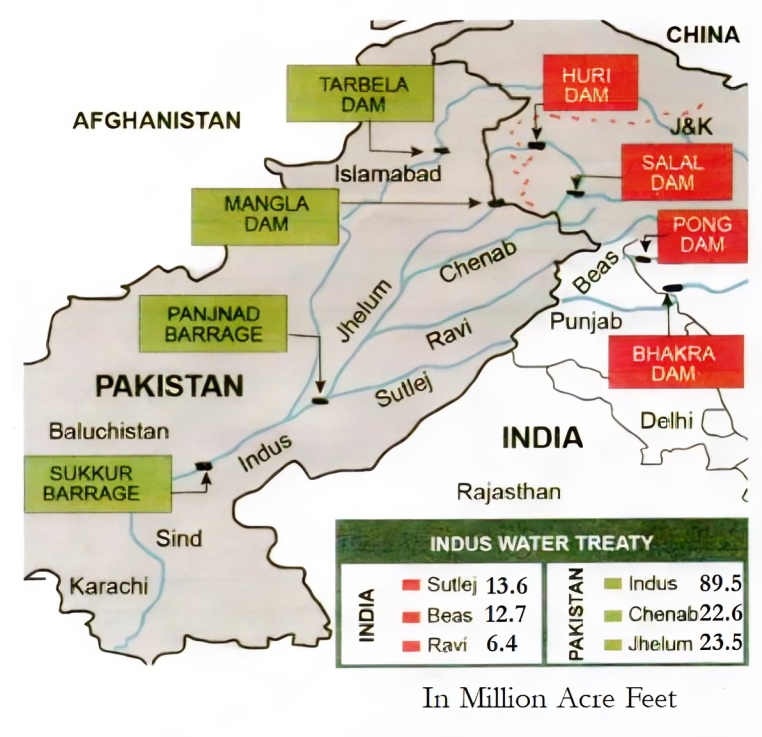
First, the IWT allocated the three western rivers to Pakistan (whose flows averaged around 135 million acre feet), namely the Indus, Jhelum and Chenab, plus the Kabul River, barring some limited uses for India in J&K. India got the entire waters from three smaller eastern rivers (whose flows averaged around 33 million acre feet), the Ravi, Beas and Sutlej, and also less minor irrigation uses for Pakistan from four canals joining the river Ravi (Ranjan, 2025). With this arrangement, Pakistan received 80.52% and India received 19.48% of the total flow of the IRS, although India’s initial demand had been for at least 25% of the total (Sinha, 2020).
Furthermore, India also had to bear the cost for replacement works towards Pakistan. India’s contribution amounted to a total of up to USD 174 million at that time, and it was a part of the USD 1 billion aid package that the World Bank and western countries had prepared exclusively for Pakistan. A transitional period was also allowed for the gradual implementation of the treaty.
Second, India may use western rivers for limited purposes only, including irrigation, run-of-the-river hydropower projects and non-consumptive uses (such as flood management, navigation etc.).
Third, in terms of specific permitted uses for India on the western rivers, the following was allowed:
- India could build hydro projects with specific design constraints (e.g., minimal storage, gated spillways etc.).
- India was permitted to develop irrigation of up to 1.34 million acres in J&K. This remains underutilized till date, with little more than 642,000 acres being achieved by 2024, leaving a balance of over half a million acres.
- India was also allowed 3.60-million-acre feet (MAF) of storage (0.40 MAF on the Indus, 1.50 MAF on the Jhelum and 1.70 MAF on the Chenab). Sector-wise allocation was 2.85 MAF for conservation storage, divided into 1.25 MAF for ‘general storage’ and 1.60 for ‘power storage’, and an additional 0.75 MAF for ‘flood storage’ (Ranjan, 2025).
Fourth, in terms of management and dispute resolution mechanisms, the following recourses were made available under the treaty:
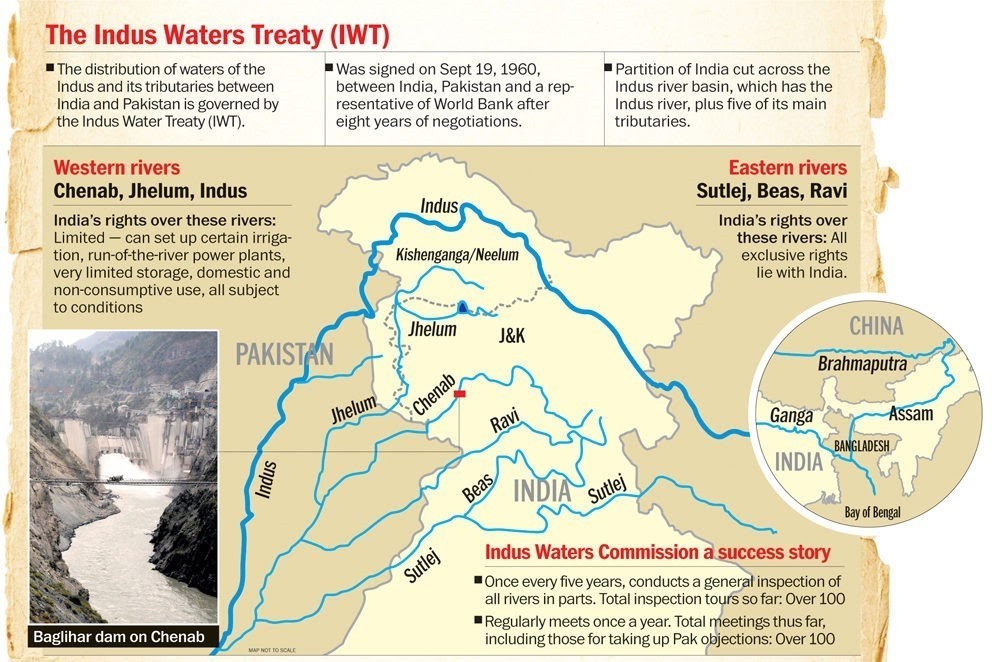
- Permanent Indus Commission (PIC): Comprising commissioners from both the countries, the PIC is a bilateral body which is supposed to meet annually to share data, resolve disputes, and inspect projects.
- In the case of a dispute under the IWT, the countries can take recourse to the following:
- PIC negotiations (mandatory first step).
- Neutral Expert (for technical disagreements, e.g. objections raised by Pakistan over the design of the Baglihar project in 2007, leading to India accommodating minor modifications suggested by the neutral expert).
- Court of Arbitration (CoA) (for legal/interpretative disputes, e.g. disputes raised by Pakistan over India’s Kishenganga and Ratle hydropower projects).
- Data Sharing: Mandatory exchange of hydrological data (flow, flood warnings). This was suspended by India in 2025 after the recent Pahalgam terrorist attack in Kashmir.
Fifth, there is no exit clause within the treaty. As per Article XII of the treaty, any modification or termination can only occur by mutual agreement between both nations.
However, despite the signing of the treaty, the fact that the origination points of the irrigation system of western rivers – the key canal headworks – remained in India, specifically in the state of Jammu and Kashmir (J&K) was a friction point that continued to generate a lot of discontent within Pakistan. The key point of discontent was that while Pakistan became overly dependent on the Indus River system for the agricultural-based livelihoods of its economy, India, being an upper riparian state, exercised control over the flow of the Indus River waters. Pakistan believed that it continued to be vulnerable to India and that it needed to control the headworks of the western rivers in J&K.
India, immediately after the signing of the treaty, witnessed tumultuous parliamentary and public debate questioning the unfair terms of the treaty. These unfair terms centered around three immediate contentions:
First, the unfairness of the terms was pointed out to Nehru at that time. At the time, of the cultivable land in India, only around 19% had irrigation facilities while in Pakistan it was 54%. Fundamentally, therefore, India was left with less-irrigated land and even fewer irrigation facilities (Sinha, 2020).
Second, the cost of replacement of the canal works which India had to bear was also based on unfair terms. Out of the 450 crore rupees required by Pakistan to build its canal links, 400 crore rupees were to be given to it as grants (and not loans). In case of India, out of the 100 crore rupees required by it to build the necessary infrastructure, only 27 crore was allocated to it by external partners, and that too as loans (and not grants, like in Pakistan’s case). Finally, India also agreed to pay 83 crore rupees to Pakistan in pound sterling without settling the previous financial dues (Sinha, 2020).
Finally, Nehru’s political outlook heavily influenced India’s agreement to signing the IWT. At that time, Nehru believed that the compromise made by India by signing the treaty was a small price to pay in exchange for security, peace and stability in the subcontinent. Influenced by his internationalist outlook, Nehru believed that the treaty could pave the way for India and Pakistan to cooperate in other areas as well. When Nehru visited Karachi for signing the IWT, as much was discussed between himself and Ayub Khan. After signing of the IWT, several rounds of bilateral talks also took place between the two countries. However, the situation drastically changed after the 1962 India-China war. In the aftermath of the war, Pakistan quickly signed a land exchange agreement with China, giving the latter a stake in the J&K dispute, and firmly became the latter’s ally. Thereafter, the 1965 India-Pakistan war broke out.
The Mirage of Depoliticization and Neutrality: IWT’s Inextricable Links with Politics
The Nehruvian idea that the IWT was merely a neutral, technical water-sharing instrument that could not only be insulated from the political headwinds afflicting the relations between the two countries but could also lead to better cooperation in other areas of bilateral engagement, was belied immediately after the signing of the treaty. In the quest for peace and in the name of better politics, India compromised during the IWT treaty negotiations, accepting merely 18-19% of the Indus Waters although 69% of the flow is from its own catchments, besides contributing millions of pound sterling to Pakistan (Saxena, 2024). To justify it at the time, Prime Minister Nehru had stated in the Parliament, “…we purchased a settlement, if you like; we purchased peace to that extent and it is good for both countries” (Punjabi, 2004).
However, soon after the signing of the treaty, Ayub Khan alluded to the necessity of the physical possession of the upper reaches of the Indus Basin Rivers in J&K. This stemmed from Pakistan’s fear of India’s upper riparian status and control over the headwaters of the western rivers. Since the major headworks of the Indus River basin flowed through the state of Jammu and Kashmir, it therefore became crucial for Pakistan to attempt to control the state, as this would solve Pakistan’s water woes, reduce the vulnerability of its agrarian economy and cease its dependency on India. For, the rivers flowing through J&K also met the water supply needs of both East and West Punjab in India and Pakistan respectively.
This, as Ranjan (2025) has argued, was visible during the first Indo-Pakistan war over Kashmir immediately after the Partition in 1947-48. After Partition, when Pakistan first attempted to invade Kashmir, one of the objectives was not only to exercise sovereignty over the Muslim-majority state,[5] but also to defend the major hydro links and hydro heads in the state (Ranjan, 2025). For, one of the major concerns of Pakistan, as Ali (1967, p. 306) points out during the first Indo-Pak war was to prevent the Mangla headworks from going to India:
If the Indian offensive succeeded, Mangla Headworks, with its control of supplies from the river Jhelum, would fall into Indian hands. In an attempt to paralyse Pakistan’s economy, India had on 1 April, 1948 shut off water from the headworks on the rivers Sutlej and Ravi, which Radcliffe had unjustly awarded to India. By getting hold of Mangla Headworks as well, India would obtain a complete stranglehold over the economy of West Pakistan. An idea of the importance of Mangla can be gained from the fact that it is the only site at which a dam is being built for the replacement of water supplies from the three eastern rivers which are under India’s control.
During the war, Pakistan and its advisors assessed that India was strong enough to capture the Mangla headworks if a ceasefire was not quickly agreed upon. This was conveyed by the then Deputy British High Commissioner posted in Rawalpindi through a telegram (dated 23rd November 1948) to a British official in the Karachi Foreign Office (Carter, 2018, p. 442):
There is, in the Army at any rate, a widespread conviction that the battle now about to be fought will be for Pakistan rather than for Kashmir. Once the Indians reach the Mangla Headworks and secure that portion of the Upper Jhelum Canal which is in Kashmir, they will have added the weapon of starvation to their already formidable military armoury. The precedent of the Ravi water earlier in the year suggests that they would not hesitate to use it!
There was, thus, widespread apprehension in Pakistan and British circles that if the war over Kashmir continued not only will the Indian side emerge victorious, but it would also command control over the major Indus headworks which would completely cripple Pakistan. This outcome was prevented as the ceasefire was announced on 31st December 1948, freezing the status quo in Kashmir.
Even after the negotiations for the IWT started in 1952, the misgivings continued to persist, and the connection with the Kashmir dispute was again brought out. This was flagged in 1957 by then Pakistani Prime Minister, Hussain Suhrawardy, when he said (Alam, 2002):
There are, as you know, six rivers. Most of them rise in Kashmir. One of the reasons why, therefore, Kashmir is so important for us, is this water, these waters which irrigate our lands. They do not irrigate Indian lands. Now, what India has done – it is not threatening – it has actually, it is building a dam today, and it is threatening to cut off the waters of the three rivers for the purpose of irrigating some of its lands.
These remarks which made a connection between the IWT and Kashmir were protested by Nehru at that time, with India asserting that there was no connection between the canal waters dispute and the Kashmir dispute. In an interview in 1963, Nehru, referring to the IWT and Pakistan’s attempt to link it to the Kashmir issue said that while the Indus water dispute had been settled by the IWT, Pakistan was attempting to raise it again in a different form by talking about the control of river head waters (Ranjan, 2025).
Post-Pahalgam ‘Abeyance’ of the IWT: A Step Long in the Making
Over the years, the politics over the hydroelectric projects built over the Indus rivers, along with the fuelling of the Indo-Pak conflict over Kashmir and the concerns over Pakistan-sponsored terrorism in India reveal that the IWT was never a comfortably settled issue between the two countries. The treaty provided a sense of security to Pakistan that India would not touch the Indus waters even as Pakistan went onto flout all norms and principles of bilateral understandings and intensified the use of terrorism as a low-cost proxy irritant to perpetually threaten India’s security. Over the years, the treaty has often come under strain and challenge, and even prior to Pahalgam, the linkage between water and terrorism was established nearly a decade ago. Therefore, India’s action of putting the IWT under ‘abeyance’ has been in the making for long.
India’s Utilization of Eastern Rivers:
In the context of the eastern rivers, the average water resource potential of the Indus basin is 73 BCM (billion cubic metres).[6] Over this flow, India has complete rights. However, not all of this water can be utilized for various natural reasons, leaving only about 46 BCM that is utilizable. India uses as much of the water as it needs to and has the capacity to store 16.3 BCM, with the left-over water flowing into Pakistan (Gujja, 2025).
Due to its numerous storage works, India has been able to utilize nearly its entire share of water of up to 95% of the eastern rivers. These works include the Bhakra Dam on Satluj, Pong and Pandoh Dam on Beas and Thein (Ranjitsagar) on Ravi. They also include other works like Beas-Sutlej Link, Madhopur-Beas Link, Indira Gandhi Nahar Project etc. (PIB, 2019). However, despite this, about 2-million-acre feet of water annually from Ravi still flows unutilized to Pakistan. India is in the process of utilizing its entire share of the eastern rivers through three key projects (PIB, 2019):
Shahpurkandi Project: The project will help in utilizing the waters coming out from the powerhouse of Thein dam to irrigate 37000 hectares of land in J&K and Punjab and generate 206 MW of power. It was temporarily suspended due to a dispute between Punjab and J&K, but has now resumed.
Ujh multipurpose project: It will create a storage of about 781 million cu m of water on river Ujh, for irrigation and power generation and provide a total irrigation benefit of 31,380 ha in J&K.
The 2nd Ravi Beas link below Ujh: This project will tap excess water flowing to Pakistan through river Ravi by constructing a barrage across river Ravi for diverting water to Beas basin. The project is expected to utilize about 0.58 MAF of surplus waters below the Ujh dam.
Whether India will be able to entirely restrict the residual flow of eastern rivers to Pakistan remains to be seen. For, as per certain estimates, India would need to build around 30 BCM additional storage capacity on the eastern rivers to store all the waters, which will require several years and billions of dollars (Gujja, 2025).
Pakistan’s Utilization of Western Rivers:
Pakistan’s population has grown 533% since 1960, reducing per capita water availability and making it one of the most vulnerable countries in the world in terms of water scarcity (Saxena, 2024). Despite this vulnerability, Pakistan has not been able to efficiently utilize its share under the IWT and has instead prioritized expending resources on waging terrorism against India.
While the western rivers constitute the primary water source for Pakistan, in terms of freshwater supply as well as agricultural dependency, Pakistan’s utilization of the waters of the western rivers has been characterized by severe inefficiencies. Of the nearly 145 million acre-feet annual inflow from the western rivers 101 MAF is diverted for agriculture, but nearly 36 MAF is lost due to leaky canals, evaporation, and outdated irrigation systems. Furthermore, nearly 30 MAF flows unused into the Arabian Sea annually. Thus, the total water wasted, including the unutilized flow to the sea, amounts to 66 MAF – twice India’s share in the Indus Waters Treaty (Saxena, 2024).
| Pakistan’s Utilization under IWT: | |
|---|---|
| Aspect | Metric |
| Annual Inflow | ~145 MAF |
| Agricultural Use | 97% of withdrawals |
| Unutilized Flow | 30 MAF to Arabian Sea/year |
| Groundwater Depletion | 0.5–1 meter/year decline |
In terms of storage capacity, Pakistan has not done well either. The country’s storage capacity has stagnated since the construction of the Mangla (1967) and Tarbela (1976) dams. These two reservoirs have a combined live storage capacity of 14.4 MAF, which represents only 10% of Pakistan’s annual share of Indus waters (Saxena, 2024). This limited storage capacity forces Pakistan to release large volumes during monsoons, causing floods within its own territory, while droughts intensify in dry seasons. This flow variability also adversely impacts hydropower generation and consequent electricity output.
Contentions over Indian Hydroelectric Projects on Western Rivers:
Contentions over hydropower projects have been taking place ever since the treaty was signed. In the process of resolving Pakistani objections to India’s just utilization of its allocated share over the Western rivers, India has deliberately compromised its interests, blindly hoping that it will buy peace with Pakistan. As a result, over many projects, India ended up making concessions that have not always been in the country’s best interests (Saxena, 2024).
One such project was the Salal dam. In 1978, the controversy over the Salal dam being built by India was settled after prolonged discussions between India and Pakistan. Pakistan objected to the storage capacity of the dam. After discussions, a bilateral agreement was signed in 1978 which reduced the reservoir height and removed the gated spillways. Presently, the dam – a 690 MW project – is in the Reasi district of J&K and is a run-of-the-river project in accordance with the IWT provisions. As a result of design compromises made by India, the dam’s operational flexibility was also compromised (Saxena, 2024). Subsequently, over the decades, Pakistan has continued to object to other Indian hydropower projects being built on the western rivers even though they were allowed under the treaty and would help India utilize the allocated irrigation potential under the IWT.
In 2007, Pakistan’s objections to the design features of the 900 MW Baglihar dam, on the Chenab River, was addressed by the World Bank-appointed neutral expert. The neutral expert upheld India’s design and mandated some minor structural adjustments to the design. In 2006, Pakistan also raised objections to India’s 330 MW Kishanganga hydropower project on a Jhelum tributary, even though it was also a run-of-the-river project. Pakistan said that the project would affect the flow of Neelum river downstream in Pakistan and impact the country’s agriculture. Pakistan took the matter to a Court of Arbitration (CoA) in the Hague. In 2013, the court ruled in favor of India, allowing the diversion of water for power generation, but also mandating that a minimum flow of 9 cubic meters per second be maintained downstream to Pakistan. The project was finally completed and inaugurated in 2018.
Yet another key hydropower project that has constituted a source of contention between India and Pakistan is the 850 MW run-of-the-river Ratle hydropower project. Pakistan raised objections to it as early as 2013, arguing that its construction design was in violation of the IWT. In 2016, Pakistan requested a Court of Arbitration on the matter, while India rejected the jurisdiction of the Court and argued in favour of bringing the dispute to a Neutral Expert instead. Initially, the World Bank encouraged both the countries to resolve the dispute bilaterally, but later the Bank appointed both a Neutral Expert and the chair of the Court of Arbitration (CoA) in 2022. While India decided to cooperate with the Neutral Expert proceedings, the country boycotted the CoA, terming it “illegal” and a “serious breach” of the treaty, as there cannot be two parallel simultaneous processes under the IWT. That the World Bank allowed both the processes to run simultaneously, in a bid to indulge Pakistan’s demands, even though the Bank acknowledged that such an arrangement will “pose practical and legal risks” shows the extent to which Pakistan has played an obstructionist role in India’s utilization of its share of the treaty (Sareen, 2023).
In 2025, the Neutral Expert ruled that he was competent to decide on the issues related to the project designs, supporting India’s stance. At the same time, in a recent ruling in June 2025, the CoA also upheld the validity of its own jurisdiction to adjudicate over the project, despite India placing the IWT in ‘abeyance’ after the Pahalgam attack.
| India’s Utilization of Western Rivers | |||
|---|---|---|---|
| Category | Key Projects/Areas | Permitted Capacity | Current Utilization |
| Hydropower | Kishanganga, Ratle, Pakal Dul, Salal | Unlimited (run-of-river) | ~5,000 MW operational |
| Irrigation | Ranbir Canal, Chenab/Jhelum valleys | 1.34 million acres | Partial (expansion ongoing) |
| Water Storage | Pakal Dul, Baglihar, Bursar (proposed) | 3.6 MAF total | ~0.4 MAF utilized |
| Flood Control | Jhelum basin reservoirs | Not quantified in IWT | Limited; expanding post-2025 |
Finally, another Indian project that has been a source of decades-old contention between the two countries is the Tulbul navigation project on the Jhelum River. The project was conceived in the early 1980s and work on it began in 1984. The project aims to regulate the water level of the Jhelum River by controlling the outflow from Wular Lake – India’s largest freshwater lake located in North Kashmir – by constructing a barrage designed to maintain a minimum water depth in the Jhelum River downstream of Wular Lake during the lean season. This is intended to ensure year-round navigation, especially during the dry winter months when river levels drop and may also have potential benefits for hydropower generation and flood control. While Pakistan argued that the project (by constructing a storage facility/barrage) violated the IWT, India argued that since the project served the objectives of navigation and flood control, it was well within India’s rights given in the IWT.
However, due to Pakistani objections, India agreed to suspend the work on the project in 1987 – again in the spirit of goodwill and in the hopes of better relations with Pakistan, even though at the time Pakistan-fomented Kashmir terrorism was at its peak. Over the years, India has desisted from reviving the project. In 2012, there was a terrorist attack – by Hizbul Mujahideen – near the project site to obstruct the routine dredging works that were going on at Wular lake, ultimately acting as a factor which contributed to the devastating floods in J&K in 2014 (Sharma, 2025). It is only now that India has decided to revive this project, and in June 2025, the Indian government commissioned a Detailed Project Report (DPR) on the Tulbul project.
Contentions over Pakistani Projects:
Besides these Indian projects, on the Pakistani side also, some projects on the Indus River have faced controversies. The 4500 MW Diamer-Bhasha Dam on the Indus River, located in Gilgit-Baltistan triggered Indian objections on international funding in the disputed territory. The project has also faced environmental controversies within Pakistan, as it will submerge more than a hundred villages. After India’s objections, while the international funding was cut back, the project is being funded by China under the China Pakistan Economic Corridor (CPEC). This is one of Pakistan’s most important projects, besides Mangla and Tarbela projects, and is expected to meet the country’s major irrigation and hydropower needs. Another important project under works is the 4320 MW Dasu dam in the Khyber Pakhtunkhwa province. It has been the target of repeated terrorist attacks, leading to temporary suspension of works.
| Key Disputed Projects on the Indus: | |||
|---|---|---|---|
| Project | River | Dispute | Resolution Status |
| Baglihar (India) | Chenab | Excessive storage capacity | Resolved by Neutral Expert (2007) |
| Kishanganga (India) | Jhelum | River diversion reducing flows to Pakistan | Resolved by Court of Arbitration (2013) |
| Ratle (India) | Chenab | Spillway design affecting sediment flow | Ongoing parallel proceedings (2025) |
| Salal (India) | Chenab | Storage capacity violations | Bilateral agreement (1978) |
| Diamer-Bhasha (Pak) | Indus | Disputed location; Chinese funding | Under construction with CPEC |
| Dasu dam (Pak) | Indus | Terrorist attacks | Under construction with CPEC |
| Kalabagh (Pak) | Indus | Inter-provincial water-sharing conflict | Shelved indefinitely |
| Key Operational Hydropower Projects in Pakistan: | ||
|---|---|---|
| Project | River/Location | Capacity (MW) |
| Tarbela | Indus, Khyber Pakhtunkhwa | 4,888 |
| Mangla dam | Jhelum, PoK | 1000 |
| Neelum-Jhelum | Jhelum, PoK | 969 |
| Ghazi-Barotha | Indus, Punjab | 1450 |
Thus, even though the IWT was conceived as a purely technical arrangement between the two countries, it has been subject to near perpetual challenges and disputes, stemming from the politics between the two countries. The precarious foundations of the IWT have faced further challenge after 2016, when India’s policy towards Pakistan-sponsored terrorism underwent a significant change.
Terrorism and Water Cooperation:
The 2015 terrorist attack in India’s Pathankot followed by the 2016 Uri attack – at a time when, just prior to the attacks, the Indian Prime Minister was attempting to revive the India-Pakistan diplomatic dialogue and had paid a surprise visit to Pakistan Prime Minister Nawaz Sharif – marked a significant shift in India’s approach towards cross-border terrorism. This was also a time when the India’s Kishanganga and Ratle hydropower projects were challenged by Pakistan and the country had approached a CoA over the Ratle project. Following the 2016 Uri attack in India in which 20 Indian soldiers were killed, India linked cooperation over shared waters to cross-border terrorism and warned that ‘blood and water cannot flow together’ (The Indian Express, 2016). In this context, India has invoked the Preamble to the treaty which emphasizes cooperation “in a spirit of goodwill and friendship”, arguing that blatant cross-border terrorism violates the fundamental basis of an already unfair treaty.
Thereafter, the challenge to the IWT has only further escalated. In January 2023, India sent a formal notice to Pakistan seeking the modification of the IWT, under Article XII (3) which deals with the modification of the treaty. In August 2024, India again sent a formal notice to Pakistan, seeking the modification of the treaty. Thus, in response to constant Pakistani objections and threats of litigation, India has been seeking a modification of the treaty for a long time, and it had officially informed Pakistan of the same in 2023. Prior to that, several IWT specialists had advised the Indian government to seek a modification of the treaty. In 2005, a former Secretary to the Indian government, Ramaswami Iyer, had proposed that the treaty be renegotiated (Sareen, 2023). One of the key arguments that India has made in seeking the revision of the treaty was to update it according to the changing environmental conditions, and to better integrate conservation and climate adaptation strategies within the treaty’s framework.
In this context, the post-Pahalgam action of India of temporarily suspending the treaty of putting it under ‘abeyance’ is not only a response to the Pahalgam terrorist attack but also harkens back to the 2016 linkage that India had warned about between terrorism and water-sharing, and the 2023 and 2024 official communications to Pakistan seeking a modification of the treaty.
The Politics of IWT Under Changing Conditions
India, in seeking the modification of the treaty since 2023 and in putting it in abeyance in 2025 has argued that there has been a fundamental change in circumstances surrounding the treaty. One important factor of this material change in conditions is the impact of environmental changes and how they have affected the flow of the Indus rivers. The Indus rivers have been primarily fed by Himalayan glaciers, and till now, these glaciers have been in a relatively stable condition. These glaciers supply around 60-70% of the Indus’s summer flow (Moneycontrol, 2025).
When the IWT was signed in 1960, it did not account for the changes to the natural environment and river flow that may be caused due to ecological and biophysical processes or due to the impacts of climate change. That is why the IWT – born out of geopolitical logic of Cold War and Partition – sought to divide the Indus River between two enemy countries based on the principle of equal apportionment of rivers, rather than equal water distribution. That is why while both the countries got three rivers each, India barely ended up receiving 19-20% of the total water flow of the Indus basin, despite retaining the headworks infrastructure. Based on a geopolitical logic, the IWT ended up being not exactly an agreement on water sharing, but an agreement for stark division of water, akin to property division. In the process, it disregarded the question of environmental conditions of river ecosystem as well as the question of just allocation of rights in any water-sharing arrangement. It ended up treating the river as a ‘thing’ to be divided, rather than as a complex ecosystem with inherent value and something that is subject to ecological changes over a period of time (Ahmadzai, 2025).
The same geopolitical logic which led the World Bank and the western governments to label the treaty as one of the “most successful” agreements in water dispute resolution (World Bank, 2018), is also the same logic which, over the decades, has led India to respect the treaty despite its unfairness and constant obstructions in the hopes of buying peace with Pakistan in the Subcontinent. It was only after 2016, when India began linking the treaty to the issue of national security and began demanding its modification that the IWT came under contention.
At the same time, besides the issue of national security, the factor of climate change and accelerated ecological changes have also necessitated a modification of the treaty and may have played a big role in India’s calculus. In contemporary times, due to the accelerating impact of climate change, there has been a melting of Himalayan glaciers, and they are estimated to be losing nearly 8 billion tons of ice annually (Moneycontrol, 2025). This has increased the risk of flooding and erratic water flows which may adversely impact water availability in the long-term. Recent assessments show that snow persistence in the Hindu Kush Himalayan region is the lowest in 23 years, with projections predicting a short-term increase in water flow, accompanied by heightened flood risk, followed by a drying of the rivers as the annual snowmelt diminishes (Amrith, 2025). Moreover, the glaciers that feed the basin are shrinking with a 23.3 percent decrease in snow cover over the last two years alone (Vishwanath, 2025).
In addition to the effects of climate change, immediate environmental degradation is also visible, as the Indus basin’s watershed area has suffered degradation and massive deforestation on both sides of Kashmir, leading to a decrease in the annual water yield (Nabeel, 2019). Pakistan’s high dependency and extractions from the Indus have made it the world’s most overstressed aquifer (Richey, et al., 2015).
It is in this context of changing material circumstances – particularly the impact of environmental changes – that India’s decision to put the IWT in ‘abeyance’ must also be considered. India’s decision hinges, therefore, not only on national security considerations, but also on the increasing irrelevance of the treaty in changing times. Given the pressing challenges facing India, including shifts in the hydrological, demographic, economic, security, and political dynamics of the country, water has become an increasingly important resource for India, and the country is under pressure to increase its freshwater endowments (Ahmadzai, 2025). Presently, India is facing a serious water crisis, with over 600 million people experiencing significant water shortages, and with the demand for water projected to double by 2030 (Ahmadzai, 2025). Due to climate change and environmental factors, the supply is likely to remain constrained and will be made worse by monsoon variability and droughts. The situation in Pakistan is even worse, as its population has increased more than five times since the treaty was signed, and it is highly dependent on water-intensive agriculture, with its major source of water being the Indus river system. Inter-provincial conflicts over water sharing within the two countries have also increased in frequency.
Furthermore, India has estimated that due to ongoing upstream projects by China and Nepal, water supply to India will be further constrained. There is no such goodwill treaty like the Indus treaty binding upstream countries like Nepal and China. China’s $137 billion Medog Dam on the Yarlung Tsangpo River, and Nepal’s hydropower projects on the Koshi and Ganga rivers are projected to significantly reduce water flow to India (Ahmadzai, 2025).
In the light of these rapidly changing environmental and water conditions, India has been demanding revised allocation mechanisms under the IWT. Abeyance, here, therefore, doesn’t mean complete abrogation of the treaty. Rather, it is a calculated, strategic step by India to bring Pakistan to the negotiating table after Pakistan ignored repeated official requests by India to discuss and modify the treaty since the last 2-3 years. Such modification of the treaty through amendments is very much permitted under the treaty. From Pakistani response to India’s decision on ‘abeyance’, it seems that Pakistan is now more open to talking to India and has said that it wants ‘normal neighbourly relations’ with India (PTI, 2025).
Conclusion
India’s ‘abeyance’ of the IWT has come at a time when Pakistan has decided to revive its policy of cross-border terrorism against India, when the national security threats from the IWT have become magnified, and when both the countries are set to face severe water shortages in the coming time. India will also face reduced water supply due to aggressive Chinese dam building on the Brahmaputra, and right at India’s border, where there is no treaty to constrain China. Whether or not India and Pakistan resolve the IWT dispute, it will not stop China from exercising its upper riparian advantages in this regard.
Presently, India does not have the infrastructure to stop the flow of water to Pakistan. In order to entirely stop the flow of water from eastern rivers to Pakistan, India would need to build an estimated capacity for about 30 BCM more which would come at an estimated cost of more than USD 15 billion, while to stop the flow of water from western rivers, India would need to build storage capacity to hold about 40 BCM, with an estimated cost which could go up to nearly USD 100 billion (Gujja, 2025). While these projects may not be realistically possible for at least the next decade or so, the ‘abeyance’ of the treaty also means that India has suspended sharing of hydrological data with Pakistan. This may affect their flood predictions and planning and can have adverse impacts on agriculture and disaster planning. China has currently suspended the sharing of hydrological data with India since 2022 for both Brahmaputra and Sutlej despite repeated appeals from the state of Assam, as it has led to frequent floods in the latter state (India Today, 2025). In the past also, as one of the first steps taken, China had suspended the sharing of data in 2017 during the Doklam standoff (BBC, 2017).
Therefore, the immediate implication of abeyance of the IWT will be on the sharing of hydrological data. In the long term, given the precarious patterns of predicted climate change and the heightened national security considerations, it is imperative for both the countries to resolve the IWT standoff. One of the main ways forward would be – as India has been attempting – to seek a modification of the treaty in line with the new realities.
Bibliography
Ahmadzai, A. (2025, April 25). The Diplomat. Retrieved from https://thediplomat.com/2025/04/the-indus-waters-treaty-colonial-legacies-cold-war-geopolitics-and-climate-challenges/
Alam, U. (2002). Questioning the Water Wars Rationale: A Case Study of the Indus Waters Treaty. The Geographical Journal, 168(4), 341-53.
Ali, C. (1967). The Emergence of Pakistan. New York: Columbia University Press.
Amrith, S. (2025, April 28). Financial Times. Retrieved from https://www.ft.com/content/ebe93133-cc7b-44b7-81e9-e7bf2a3595d0
BBC. (2017, September 18). British Broadcasting Corporation. Retrieved from https://www.bbc.com/news/world-asia-41303082
Carter, L. (2018). Towards a Ceasefire in Kashmir: British Official Reports from South Asia, 18 September-31 December 1948. London: Routledge.
Chaturvedi, A. (. (2018). Indus Water Treaty: An Appraisal. New Delhi: Vivekananda International Foundation.
Gujja, B. (2025, June 5). The Wire. Retrieved from https://thewire.in/south-asia/indus-treaty-can-india-stop-all-the-water/?mid_related_new
India Today. (2025, May 28). India Today. Retrieved from https://www.indiatoday.in/india/story/china-has-not-shared-river-data-with-india-since-2022-rti-query-reveals-exclusive-2731993-2025-05-28
Moneycontrol. (2025, April 26). Moneycontrol . Retrieved from https://www.moneycontrol.com/news/india/indus-waters-treaty-postcolonial-story-role-of-world-bank-and-pakistan-s-complete-dependence-13005682.html
Nabeel, F. (2019, February 21). Down To Earth. Retrieved from https://www.downtoearth.org.in/water/how-india-and-pakistan-are-competing-over-the-mighty-indus-river-63321
PIB. (2019, February 22). Press Information Bureau. Retrieved from https://www.pib.gov.in/PressReleasePage.aspx?PRID=1565906
PTI. (2025, July 5). Hindustan Times. Retrieved from https://www.hindustantimes.com/india-news/pakistan-says-it-desires-normal-neighbourly-relations-with-india-101751683311992.html
Punjabi, R. (2004). Indus Waters Treaty – Human Security Vs. Military Security. Journal of Peace Studies, Vol. 11, Issue 4.
Ranjan, A. (2025). Indus Waters Treaty Negotiations: Geopolitics, Disputes and Cooperation. South Asia Research, 45:1, 110-131.
Richey, A., Thomas, B., Lo, M.-H., Reager, J., Famiglietti, J., Voss, K., . . . Rodell, M. (2015). Quantifying renewable groundwater stress with GRACE. Water Resources Research, 51:7, 5217-38.
Sareen, S. (2023, January 28). Observer Research Foundation. Retrieved from https://www.orfonline.org/expert-speak/indus-waters-treaty
Saxena, P. (2024, August 23). NatStrat. Retrieved from https://www.natstrat.org/articledetail/publications/the-indus-waters-treaty-why-pakistan-s-obsession-does-not-mask-its-failure-158.html
Sharma, S. K. (2025, June 4). Organiser. Retrieved from https://organiser.org/2025/06/04/295402/bharat/indus-water-treaty-drowned-and-dead/
Simha, R. K. (2016). Indus Waters Treaty: Nehru’s Original Himalayan Blunder. Swarajya.
Sinha, U. K. (2020). The Nehruvian imprint on Indus Waters Treaty. New Delhi: Hindustan Times.
The Indian Express. (2016). Blood and water cannot flow together: PM Modi at Indus Water Treaty meeting. New Delhi: The Indian Express.
Vishwanath, A. (2025, May 9). The Diplomat. Retrieved from https://thediplomat.com/2025/05/indias-indus-waters-treaty-suspension-what-happens-next/
World Bank. (2018). Fact Sheet: The Indus Waters Treaty 1960 and the Role of the World Bank. World Bank.
- This is only 10% when Aksai Chin area of Laddakh – under Chinese control – is excluded. ↑
- In 1950, once India and Pakistan were recognized as separate countries, the United Nations (UN) gave recognition to the Inter-Dominion Agreement, along with a host of other pre-1950 arrangements. ↑
- While Pakistan readily accepted the mediation by the World Bank calculating that it would get an advantage by the virtue of being America’s ally, India was suspicious of the mediation offer. However, when the World Bank chief emphasized that such mediation was only confined to the functional, and not political, aspects of the disputes and was, therefore, isolated from the larger India-Pakistan question, India also decided to accept the services of the World Bank. ↑
- This basic assumption has now come under grave challenge in the light of ecological degradation of the Indus basin and the projected impacts of climate change on water flows within the river system. ↑
- Presently, 30% of J&K is in Pakistan, 55% in India and 15% is with China (Ranjan, 2025). ↑
- The total average annual surface water availability of the basin is about 239 BCM, out of which the average water available from the western rivers is 165 BCM, which is allocated to Pakistan. ↑
