
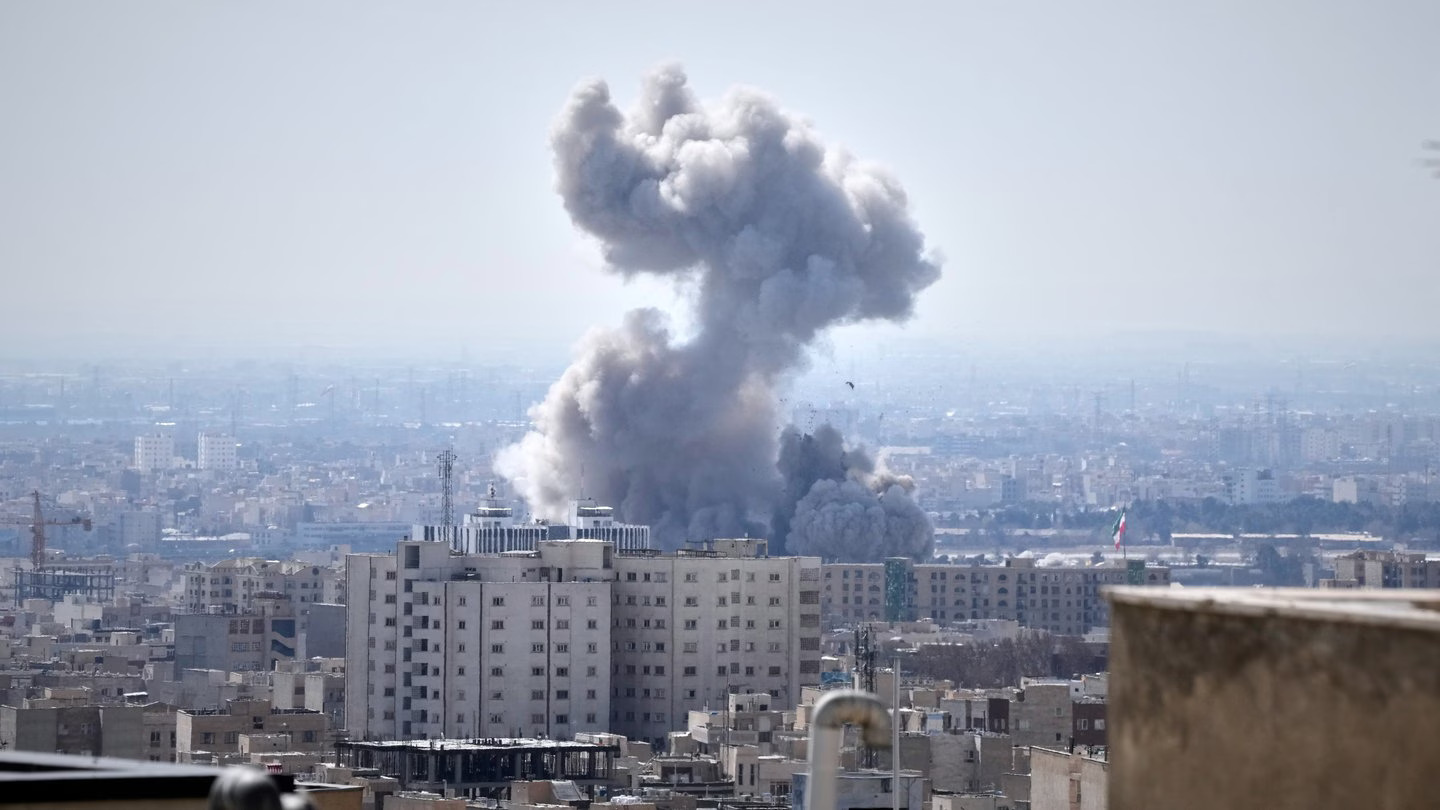
The continuation of the Iran war for over a month once again brings to the fore the rapid changes in international politics, and the limitations of negotiations and diplomacy in the face of a terrorist regime masquerading as a legitimate state. Amid the then ongoing diplomatic negotiations between U.S. and Iran mediated by Oman, U.S. and Israel jointly launched a sudden attack on Iran on February 28th, followed by further successive attacks. The attacks decapitated significant Iranian military leadership along with the former Supreme Leader, Ayatollah Khamenei. The primary calculus of the U.S. and Israel was that the initial decapitation of top military leadership including the Supreme Leader of Iran would deal a heavy blow to the Iranian morale, significantly derail their capabilities and act as a trigger for regime change. The death of Khamenei was especially calculated to effect this. Potentially, such a regime change could have been made possible by also fomenting unrest among Kurds and Baloch separatists. Netanyahu and Trump even gave public calls for regime change. However, this did not materialize, and the war has significantly expanded since then.
1. Why Diplomacy Failed: Historical Inevitability of Conflict
A major contentious issue that has polarized the international public opinion is whether, contrary to diplomatic protocols, the U.S. and Israel should have launched strikes on Iran in the middle of negotiations. It is based on this contention that nearly all the major European countries have refused to condone the U.S.-Israeli action against Iran, and even when Trump demanded the mobilization of forces of the North Atlantic Treaty Organization (NATO), they have refused to come forward. This shows that the international public opinion is not only based on short historical memory, but also political expediency in which European governments increasingly find themselves catering to the rising Muslim migrant vote bank in their countries. The latter consideration has largely blinded them to both history and future uncertainty.
Historically, after the elimination of the erstwhile regime of Shah Pahlavi and the rise of the Islamic regime after the 1979 revolution, Iran transformed from an ally of the U.S. and Israel into one of their worst enemies. Militarily, after facing and successfully surviving the war with Saddam Hussein’s Iraq during the 1980s, the Iranian regime began to consolidate itself. Ideologically, its consolidation of repressive, theocratic Islamism in the domestic domain to exercise control over its citizens was coterminous with its projection of Islamic ideals as also the basis of its foreign relations and geopolitical power projection. The two spheres reinforced each other, with strong religious-ideological power projection abroad used as a means to reinforce authority at home and counter any dissent by its own citizens. In this quest to establish and expand itself, the Palestinian cause became the regime’s prime constitutive substance, while the Iranian Revolutionary Guard Corps (IRGC) became the prime means. This happened in three significant ways:
1.1 Regional Power Projection and Cultivation of Proxies:
First, the championing of the Palestinian cause – even though it was for the Sunni Muslim people – helped the regime to portray itself as not only distinct from other Muslim countries in the Gulf, but also as a regime which rose beyond the Shia-Sunni divide and sought to project leadership in a unified Muslim world. This was in consonance with the long-embedded Iranian regime’s ambition of exercising regional hegemony. Prior to the 1979 Revolution, the Pahlavi regime too attempted to expand its regional dominance, by building unparalleled military and technological strength, largely on the back of the American-Israeli support, and had often intervened in the political affairs of other Arab countries.[1] While the 1979 Revolution marked a drastic regime change, the new Islamic regime had inherited this deep-rooted instinct of the Shah regime and continued to work on expanding its regional hegemony. Only the tactics had changed, as the American-Israeli coalition was now viewed as a prime adversary, and the championing of the Islamic cause at a regional level – primarily through leveraging the Palestine issue – gave the regime its unique identity.
This distinctiveness was further aided by the fact that after their defeat in the Yom Kippur War against Israel in 1973 and after their failure to sustain the oil shock to teach the U.S. a lesson, the Gulf countries waded more deeply into the American ambit. After the oil shock, U.S. and Saudi Arabia signed an agreement in 1975, where Saudi Arabia committed to sell oil to countries only in the U.S. dollar and reinvest massive surplus from oil revenues into the U.S. economy, thereby giving birth to the ‘petrodollar’ arrangement, where all countries were forced to buy dollars in order to get access to the Gulf oil. Other Gulf countries also toed the Saudi line. Egypt went even a step further and became the first Arab country to recognize Israel in 1979, a deal again mediated by the U.S. through the 1978 Camp David talks. This was followed, in 1994, by Jordan recognizing Israel in 1994, in return for a variety of benefits, again mediated by the U.S. While the Gulf countries continued to exercise pressure on Israel over the Palestinian issue, U.S. ensured that a working balance was maintained between its two sets of allies.
The rise of the Iranian regime and its focalization of the Palestinian liberation to project its regional power should be seen in this context. It helped Iran bring into sharp relief the insincerity of the Gulf’s commitment towards the Palestinian cause, given their deep-rooted alliance with the U.S.-Israeli interests. With Israel striking an agreement with the Palestinian Liberation Organization (PLO) in 1993 through the Oslo Accords, Iran cultivated the recently formed terrorist organization, Hamas, to launch successive Intifadas against Israel. In so taking up the Palestinian cause, Iran found its raison d’être, which inevitably led the regime to remain on an irreversible collision course with the U.S.-Israel combine. It especially went a step further in the case of Israel, openly calling it a Satanic, illegitimate formation and harbouring its destruction.
Over the decades, through the IRGC’s international arm, the Quds force, the regime has been able to successfully cultivate terrorist organizations – such as, Hamas, Hezbollah, Iraqi (Khatib) Hezbollah, Houthis and other actors – to wage proxy warfare against Israel, destabilise the region, and exercise control over the state apparatus of countries like Lebanon, Syria and Iraq. What it could not achieve through direct conventional warfare where it understood it may face losses, the regime made up through proxy warfare. The manifestoes and programmes of these Iranian proxy organizations were hinged around the common cause of not only Palestinian liberation, but also the extermination of Israel. These outfits also established themselves as part of the governance structure of power-sharing in the territories where they operated from, including Lebanon, Gaza, Iraq and Yemen.
1.2 Domestic Power Consolidation:
Second, on the domestic front, the regime’s regional power projection helped to reinforce its control over its own citizens in the most brutal ways. After the 1979 Islamic Revolution, the new regime purged all elements of the military and police that were loyal to the Shah. Instead of relying on the traditional forces to maintain stability, the then Ayatollah Khomeini cultivated a new coterie of loyalists nurtured based on the ideals of Islamic fundamentalism and commitment. This ensured that there would be no counter-revolution and the regime survived. Due to the overreliance and trust placed in the IRGC, the organization not only became a top military formation, but also became deeply embedded in Iranian society. Nearly all top political leaders and diplomats have gone through the ranks of the IRGC. Its role has continued to expand, and it called the shots not only on military decisions, but also political, economic and cultural issues. Most recently, the regime’s successful absorption of the costs of the recent assassination of Khamanei showed that the IRGC’s decentralized, loyalist power structure has been the driving force behind the regime, and has enabled it to not only penetrate the social and political structure, but also ensure resilience even when nearly the entire top brass of the Iranian leadership was eliminated, in the present and the last year’s wars.
This model has enabled the regime to exercise complete domestic control, despite accumulating psychological discontent against the regime. Over the years, every time the elections yielded moderate leadership, the permanent council of the Supreme Leader systematically marginalized and curtailed it. Imposition of sanctions by the U.S. crippled the Iranian economy over the years, leading not only to popular revolts, but even producing a deep hatred towards the Islamist ideals especially among the youth, majority of whom preferred alternatives such as atheism. Much like the Quds force abroad, the IRGC also established the ‘Basij’ militia to control its domestic front and ensure that popular uprisings fail. Despite such tight controls, Iranians have risen up in protest against the regime, with some of the major protests being witnessed in the late 1990s, the early 2000s and have increased in frequency in the last few years, especially led by women.
Yet, as the most recent January 2026 protests show – leading to the most brutal crackdown and death of the Iranians at the hands of the regime – regime change has been unsuccessful. Even the U.S.-Israel war on Iran this year, which was expected to bring protestors on the streets once more and topple the regime after Ayatollah’s death, did not work. This domestic control has been a key source of the sustenance of the regime. In the cases of many other Arab countries, regime change has been effected either by direct ground operations (as in the case of Saddam’s Iraq) or by triggering popular revolt and civil war (as in the case of Libya under Gaddafi). In the Iranian case, ground operations were not conducted due to the American public’s opposition to sending boots on the ground, while the fall of the topmost regime leaders has not even led to a civil war, which the U.S. and Israel were banking on. The failure of the latter became explicable as the deep reach of the IRGC has been revealed in this present war.
1.3 Systematic Militarization:
Third, the regime systematically built up its arsenal of military power and especially undertook nuclear enrichment. Aid from Russia, China and North Korea, oil exports through means such as shadow shipping, and ineffectivity in monitoring the enforcement of sanctions, among others, has helped the regime cultivate a parallel economy to circumvent the sanctions and keep afloat. Most importantly, despite publicly claiming that it would not develop a nuclear bomb and seeks enrichment only for the purpose of civil nuclear energy use, by the time the Joint Comprehensive Plan of Action (JCPOA) was initiated in 2016 between Iran and the Western countries, Iran was able to reach a level of Uranium-235 enrichment of up to nearly 20%, a level which is regarded as ‘highly enriched’ and is far above the 3% to 5% enrichment range that is required for civilian use of nuclear energy. Even this 3% to 5% range of enrichment is required only for advanced light water nuclear reactors. For traditional pressurized heavy water nuclear reactors (PHWRs), no enrichment is required and they can run on natural uranium to generate electricity. Countries like India[2] and Canada work on this model. Others like South Korea, which generates nearly a third of its energy from nuclear, do so by importing enriched fuel from supplier countries lawfully, rather than enriching their own uranium.
There are, thus, many ways to delink civilian nuclear energy from fuel enrichment, and there are countries which work on this model, by either using imported enriched fuel or running PHWRs through natural uranium. This makes Iran’s insistence on progressive enrichment even more suspect. Presently, Iran possesses more than 440 kilograms of 60% highly enriched uranium, which makes the country only a short step away from achieving ‘weapons grade’ enrichment level. Once that is done, building a bomb would hardly take more than a few weeks – with almost 440 kg of enriched uranium, Iran could manage up to 9 to 12 nuclear bombs. Even with 60% enrichment level, Iran could produce basic nuclear explosive devices. More dangerously, even if Iran stops further enrichment and directly build a nuclear warhead with what it has, it will only take about 40 kg of fissile material to build a weapon with a kiloton yield. Thanks to its exchanges with North Korea, Russia and China, Iran has also consistently built up its ballistic missile programme, along with a large arsenal of cheap technology, including drones and decoys.
1.4 A Case Unfit for Diplomacy:
Together these three factors – regional power projection, domestic control and effective militarization – have enabled the survival of the regime and made its intentions plain. All three factors hinge on one key desiderata – seeing to the liberation of Palestine and the decimation of Israel. This was the reason for the regime to justify its existence and the means used by it, and argue that the achievement of this objective advances the cause of Islamic religion and ideology. No amount of diplomatic outreach and negotiations could possibly dilute the fact that the avowed reason for the existence of the Iranian regime is to see to the destruction of Israel.
Israel has always had full clarity on this. That is why Israel had attempted to scuttle the 2016 JCPOA deal with Iran, knowing that merely restricting nuclear enrichment and ensuring compliance through inspections is not going to be effective in stopping Iran. For Israel, military action to ensure regime change is the only viable alternative. This especially became a permanent fixture of the Israeli approach after the October 2023 Hamas attack on Israel. The attack has propelled Israel into a state of permanent war against not just Hamas, but all Iranian regional proxies and against Iran itself.
Over the last three years, Israel has systematically degraded the capabilities of Hezbollah and Hamas, leaving them largely ineffective, ensured the fall of pro-Iran Assad regime in Syria and triggered a process of direct attacks against Iran. In early 2024, the first instance of such direct attack came when Isreal bombed the Iranian consulate in Damascus, in violation of international norms of diplomatic immunity. In 2025, the ascendance of the second Trump administration hardened the Israeli determination to finish the Iranian regime even more, with the U.S. and Israel launching a 12-day war against Iran and significantly degrading its military capabilities. In 2026, after the worst anti-regime protests since 1979, U.S. and Israel have launched the present war. Being engaged in a state of permanent war on several fronts against Iran and its proxies has accustomed Israel to this warfare.
Through all of this, the recalcitrant behaviour of Iran and its refusal to commit to curbing nuclear enrichment leaves little scope for diplomacy. Israel realizes that any diplomatic understanding with the existing regime would only provide it a form of breathing space to recuperate and hasten its weapons programme. That is why during the latest war, both U.S. and Israel started out with the war objective of regime change. While the U.S. has vacillated, Israel continues to uphold regime change as its primary aim, and has refused to participate in any ceasefire discussions. Under such conditions, diplomacy without concrete Iranian commitments on demilitarization and non-pursuit of nuclear weapons would merely be facile.
2. What the Present War is Leading To: Changing Regional Structure and Principles
As is clear from the fraught political background of Iranian intentions since 1979, the inapplicability of diplomatic principles in the war being currently waged lies primarily in Iran’s status and behaviour as a rogue actor harbouring a genocidal policy towards Israel. Despite the current bout of opposition to the war and, in some quarters of the world, and even sympathy for Iran, the Iranian duplicity is becoming more exposed as the war continues and attempts at negotiations repeatedly fail. This is now turning into what looked like an initial Iranian strength into a weakness, that is, the military strategy to absorb losses and wage a war of attrition.
2.1 The Inevitable Military Reverses:
Originally premised on waging a war of attrition, Iran has been able to sustain the U.S.-Israeli military campaign, although at a significant cost. The 12-day war fought between U.S.-Israel and Iran had led to a significant degradation of Iranian arsenal. The present war, coming in less than a year, therefore necessitated a change in Iranian military strategy. In the present war, Iran has followed a layered three-pronged strategy:
First, given the incommensurate and weak military arsenal and capabilities, Iran has had to rely on waging a war of attrition in the expectations that it will eventually wear out the enemy. However, this has been difficult to achieve, as the enemy is not just any country, but two of the most powerful nuclear-armed militaries in the world. Therefore, Iran realized that the attrition strategy might work in the reverse direction too, leading to exhaustion of Iranian capabilities as the war drags on.
To minimize the effects of this possibility, Iran has, therefore, supplemented its application of advanced ballistic missiles with the use of cheap drones and decoys. These have worked well in the field, and in many cases, struck their infrastructural targets with precision. They have also been difficult to counter, as their altitude is not very high enabling them to enter enemy territory undetected, while their replenishment cost is low, with estimates indicating that it is not very feasible to destroy a cheap drone costing between $20,000 to $50,000 with a Patriot missile interceptor whose single strike would amount to a cost of nearly more than a million dollars. Further, as these interceptors remain continuously engaged, their capabilities also weaken over time. This became evident last year when, during the 12-day war, Iranian missiles were, at a later stage, able to circumvent Israeli interceptor systems, causing damage in Israel. In the present war, this strategy has worked well for Iran, at least in the initial phases of the war. Its results were visible in the fact that the U.S. had to transfer its Patriot missile, THAAD and other interceptor systems from the East Asian region to the Middle East, leaving countries like South Korea vulnerable.
Iran has also supplemented its military action with the use of short-range missiles which were successful in striking down a U.S. fighter jet. Moreover, apart from leveraging its massive underground ‘missile cities’ which have already been heavily bombed by the U.S. and Israel, Iran has more effectively used mobile launchers to launch these missiles. These launchers – even though overground – do not remain static and are much more difficult to target. These have mainly helped Iran to sustain steady missile attacks on its adversaries.
In terms of capabilities, Iran’s decentralized command and control system has helped it sustain the war of attrition in the initial phase. This decentralized system forms a part of what is known as the ‘mosaic’ defence strategy used by Iran, where even when top leadership is eliminated, the chain of command does not suffer, and local commanders at every level are trained and empowered to take crucial decisions – unlike the autonomy offered in typical authoritarian regimes. This ‘decentralised mosaic doctrine’ is designed to survive decapitation, similar to ones undertaken by the U.S. and Israel. Therefore, no vacuum is created. At the same time, the strategy also includes a chain of communication, using fibre-optic networks, field telephones and physical messengers, to minimize Israeli espionage.
The cultivation of such intricate strategy shows how Iran has been preparing for this war for decades. This became evident through the fact that the regime did not only adjust quickly to elimination of its top leadership during the war, but could also respond in kind to specific attacks. These capabilities were shown when Iran significantly damaged Israel’s Dimona town which houses its secret nuclear facilities, in response to Israeli strikes on Iran’s Natanz facilities.
However, the limitations of Iran’s military strategy became visible when it was confronted with the need to, both, sustain the war as well as preserve its scarce military resources. To do so, Iran leveraged its capability to conduct coordinated attacks, albeit lesser in number, with precision. Thus, over the course of the war, while the number of Iranian missile attacks have gone down, they were able to destroy some adversary fighter jets, surveillance aircraft and other infrastructural assets with precision. In the context of the war, however, these capabilities, however effective, have not been able to carry Iran very far. This became evident from the fact that, as the war progressed, daily Iranian missile attacks on Israel stabilised at around 7 to 15 launches, which Israel could predictably deal with. Similarly, the expectation that Iran’s strikes on U.S. military bases in the region would cause significant damage has also not been borne out.
Second, a crucial part of the Iranian strategy was to expand the war to a regional level, to escalate its costs on other actors involved. In the present war, Iran continues to fire ballistic missiles at Israel and the other Gulf countries in the region, with the United Arab Emirates (UAE) becoming a particular target in view of its partnership with Israel. Others like Qatar, Saudi Arabia, Kuwait and Bahrain have also been in the line of consistent Iranian fire. However, this regional escalation has had only limited effect. While the Gulf countries did face an interim stretching of their military resources, especially the interceptors, they were able to engage Iranian short-range missiles in a way that there were minimum casualties.
Red lines were crossed when there were partial attacks on the regional energy infrastructure, including the American strikes on the Kharg Island which has Iran’s major oil export centre. While the U.S. strikes avoided the energy infrastructure on the island, Iran’s naval and missile storage facilities located there were struck. Other notable red lines included Isarel’s unilateral attack on partial energy infrastructure by striking the Iranian South Pars gas field, leading to retaliatory Iranian strikes on Qatar’s Ras Laffan gas field. Both form a part of common resource base, thereby decimating production capacity for sometime. Apart from these escalations, the present phase of the war has largely steered clear of, or else pulled back from, any major damage to the regional energy infrastructure.
Third, realizing that the other two measures will only work up to a point, Iran also undertook an illegal closure of the Strait of Hormuz, a critical narrow waterway through which a third of the world’s oil and gas transits, and on which countries like India, Pakistan, China, Japan, South Korea and others are heavily reliant. This was used by turn to influence the world public opinion and turn it against America and Israel. Predictably, the engagement of various countries with Iran increased, as they began to negotiate for permitted passage through the strait, and even hardcore U.S. allies like South Korea turned against Israel.
2.2 When Politics Backfires:
This three-pronged strategy, and layered response, has helped Iran in at least surviving the American-Israeli onslaught for more than a month. By now it is widely known that, during their meetings in February, Netanyahu had convinced Trump – despite opposition from top American military brass – that a quick decapitation strike eliminating much of Iran’s top leadership will lead to a toppling of the regime. However, they had not factored in Iran’s ability to survive consistent decapitation attacks and yet maintain the chain of command. This has enabled Iran to sustain the war, despite suffering heavy losses and being on the brink of defeat. As things stand, despite Trump’s interim declarations of victory, and claims that U.S. jets are freely going in and out of Iran, the survival of the regime is alone enough to counter-balance the military success of the U.S.-Israeli operations, making them look more like tactical battlefield successes rather than a final victory.
It is here that the status of the Gulf countries begins to matter. The key Iranian strategy of regionalizing the war, by expanding attacks to the Gulf countries has had an opposite impact to the one Iran had expected. Iran’s assumption has been that attacks on the Gulf countries will make them realize the costs of associating with the U.S. and Israel, leading them to view the U.S.-Israeli initiation of operations against Iran unfavourably as a disruptor of regional peace. Instead, the opposite has happened. The Gulf countries have become even more tightly knit with the U.S.-Israeli offensive, viewing its success as the only way to ensure regional peace. Issues which have historically been of prime significance to regional politics – especially Palestine, and Islamic solidarity – have all been discarded.
Instead of the long-embedded ideal of Islamic unity, conceived through the working lens of Palestinian solidarity, the present war has given rise to what already existed in an implicit manner – Arab commercialism anchored to American-Israeli linkages, and necessitating the latter’s security umbrella. The coming out of this in the open has significantly changed the regional political architecture. At least three major ways in which this has happened are already evident:
First, the original raison d’être for the existence of the Islamic regime in Iran – the Palestinian cause around which regional Islamic solidarity was networked – has now been openly relegated to the extreme sidelines. Even the pretence of solidarity with the Palestinian cause has flown out of the window, as this issue is being linked to the politics of Iran and the terrorism of its proxies like Hamas, rather than being viewed as an autonomous issue of self-determination. This destroys considerable Iranian ideological leverage over the region.
Second, because of the regionalization of the war by Iran, Arab countries now espouse more keen interest in seeing to the decimation of Iran than even the U.S. and Israel. Till now, Iran has been an existential threat to Israel, but after this war, the survival of the regime in any form will be conceived as a significant threat to the Gulf states as well. Their biggest apprehension is that if the U.S. ends the war only superficially, then Iran will get the breathing space to not only recuperate in terms of its military capabilities but also build the nuclear bomb and become further dependent on asymmetric warfare. The Arab countries realize that they would be targets of the decades of asymmetric warfare that Iran has perfected. Therefore, contrary to the Iranian expectation that the war will make Gulf countries turn away from the U.S., the opposite will happen.
Till now, a unified regional security architecture was lacking in the Gulf, due to many mutual divergences on security issues, including threat perceptions and partnerships. After this war, the Gulf countries will certainly set aside these differences and devise a common security regime, including military coordination, to prevent a repeat of the current Iranian attacks. Further, the Gulf is likely to continue depending on the U.S. military umbrella and engaging with Israel more openly. Other alternatives are not available. They cannot fully rely on Pakistan, as that would mean inevitable dependence on Chinese military supplies, which they believe would be unreliable. For, despite the Chinese help in cultivating Saudi Arabia’s ballistic missile programme and striking a defence partnership with the UAE, China has refused to come to these countries’ aid and would be unlikely to get involved in future regional conflicts as well. The U.S. is the only country, in the Gulf view, which would undoubtedly intervene, for good or for bad, to ensure regional stability. No other country has that appetite.
Finally, the regionalization of the war by Iran is linked to another consequence whose effects may become visible over the years – dilution of conventional Islamic hardline fundamentalism. Thanks to the systematic modernization and commercialization already being undertaken by major Arab countries such as Saudi Arabia, UAE and Bahrain, this dilution had already started taking place over the last few years. Within Iran itself, some surveys show that majority of the population identifies as atheist, with young people being largely liberal. Instead of being primarily theocracies with religion as their driving force, Arab countries and Iran are now mainly political autocracies with religion being more of a superficial legitimizing force rather than a genuine motivation.
As these countries become more ensnared in the web of commercialism and technology, this dilution of religion will further increase. The present war has coupled this ongoing movement with an additional arrangement where rivalries within the Islamic countries may become irreconcilable. Where nothing so far could halt the march of Islamic fundamentalism, inter-Islamic rivalry will hasten this process.
3. No Alternatives to Regime Change
The ongoing war has made at least two immediate aspects of this regional crisis quite evident. These are:
First, diplomacy alone cannot be a solution to resolve conflicts with a fundamentally hostile regime whose very reason for existence hinges around fulfilling the destruction of its perceived enemy – in this case, Israel and the Jews. Even past attempts have failed in this regard. This is something that America needs to grasp. In 2003, despite Iran’s understanding with Europe that it will not undertake enrichment, it continued to do so, leading to its public disclosure of successful enrichment by 2006. Despite this, Obama initiated talks with Iran in 2013, when the moderate Hassan Rouhani came to power, leading to the conclusion of the JCPOA in 2016. The conditions in the JCPOA were so flimsy that Israel had rightly opposed it. The agreement restricted enrichment for a few years, subject to regular inspections, and then allowed a phased removal on enrichment restrictions after 2030. Given these facile diplomatic understandings which Iran regularly exploited, Trump rightly gave in to Israel and discarded the JCPOA, asking for complete ban on enrichment and development of the so-called peaceful, ‘civilian’ nuclear programme.
As the Iranian trajectory shows, for such regimes, diplomacy merely becomes a cover to expand their nefarious agenda. Diplomacy can only apply to legitimate states that follow international law, and not to pariah terrorist states that harbour stated genocidal aims. And yet, after more than a month of difficult war, the U.S. is once again seeking a desperate exit through facile diplomatic means. This vacillation is, perhaps, the biggest American weakness which Iran attempted to exploit – that America is not clear in its war objectives. It undertook the war at Israel’s behest, and changed the goalposts, somewhere along the way, from regime change to demilitarization and destruction of the ballistic missile programme of Iran.
True to his nature, Trump, instead of talking about regime change, started talking about how he would play a role in appointing Iran’s next Supreme Leader, offering immunity to potential IRGC defectors and indicating that an agreement on nuclear deal with the regime was still possible. At some point, he declared that he had won the war, even as Iran’s attacks continued. The U.S. even spread an interim rumour that there were backchannel talks between the U.S. and Iran, which Iran denied and labelled a tactic to calm the energy markets. U.S. Secretary of State, Marco Rubio, even publicly differed from Netanyahu on the question of regime change. All this has exposed the U.S. weaknesses thoroughly, so much so that even their much stronger military arsenal, capabilities and battlefield superiority could not compensate for their lack of depth. Contrast this lack of clarity in American objectives with Iran’s clarity. For Iran, the objective of this war is not to win, but to merely resist, survive and restore their deterrent. It has not signalled any dilution of its position throughout the war.
Second, this vacillation in the American outlook is at odds with Israel’s approach, which has always been single-minded in its objectives, much like Iran. Israel has been clear right from the beginning that it seeks complete elimination of the Iranian regime in its present form. For Israel, neither regime degradation nor denuclearization nor demilitarization would be of much value if the regime survives, because the regime will then always retain the capability to reassemble and remilitarize. Netanyahu has been stressing this basic point to successive American administrations for years. He has consistently made the argument that the Iranian regime is an existential threat which can neither be managed nor contained but only eliminated.
Despite this, Obama and Biden gave partial sanctions relief to Iran in exchange for vague assurances, while the Trump administration is afflicted by a lack of clarity and consensus on the key objective and appears to be concerned only with declaring a victory in the immediate war, which would allow them to make an exit. In the present war, despite the joint operation by the U.S.-Israeli alliance, the fundamental difference that Israel seeks regime change, while the U.S. now merely seeks nuclear disarmament has created a huge gap which is diluting the alliance’s psychological position vis-à-vis Iran; for, the two objectives are not the same. This weakness is also translating into battlefield restrictions, preventing the U.S.-Israeli alliance from going all the way. Notable instances include Trump’s refusal to initiate ground operations, while pushing Israel under the bus for attacking Iran’s energy infrastructure in the South Pars gas field.
Since the basic position is not clear, the Iranian regime, despite being heavily weakened continues to survive, even as the U.S. inches closer to sealing an exit deal through formal mediation conducted by Pakistan. Any conclusive deal in this regard would merely circle the U.S.-Israeli alliance back into the restrictive circle of diplomacy and ensure regime survival for Iran. Even if, in any future deal, Iran makes all the concessions that the U.S. seeks, from nuclear disarmament to ending support for their terror proxies, the regime survival would still have been ensured. The possibility of such regime survival also means a survival of all its values and genocidal intent, which could be revived actively anytime into the future. The present war offered an opportunity to end this cycle once and for all, but the present orientation of the U.S. appears to be leading this crisis once more into a status-quoist direction.
4. The Place of War
“War is physically an evil, a calamity; morally it has been like most human institutions a mixture, in most but not all cases a mixture of some good and much evil: but it is sometimes necessary to face it rather than invite or undergo a worse evil, a greater calamity. One can hold that, so long as life and mankind are what they are, there can be such a thing as a righteous war, – dharmya yuddha. No doubt, in a spiritualised life of humanity or in a perfect civilisation there would be no room for war or violence, – it is clear that this is the highest ideal state. But mankind is psychologically and materially still far from this ideal state.” – Sri Aurobindo (CWSA 36, 2006, pp. 461-62).
The pervasiveness of war in the present times has brought into question the delicate and superficial edifice of ideals and institutions upon which the world order had based itself. The scourge of the Second World War had presented a very clear choice between good and evil and had evoked a deeper aspect of the collective human spirit, which gave it decisive victory. And yet, as we cultivated our materialistic and scientific progress and built institutions over the decades, it was inevitable that this spirit would be shadowed by contrary impulsions. We made multi-pronged progress in all directions, ranging from science to military, but all for the satisfaction of the collective national vital ego.
The inevitability of the present wars and the hardships they bring have finally acted as a break in this trajectory. Like the wars in the past, the recent wars have had this effect. The Russia-Ukraine war transformed Ukraine into a strong nation-state with a distinct identity which would never again be subsumed. It also evoked a conscious collective spirit among its people. The India-Pakistan war broke the Indian down-spiral of complacency and moral turpitude, albeit through hardship and unexpected shocks. Even small countries – known mainly for their tourist attractions – such as Thailand and Cambodia have not been exempt from this wave of war spirit currently sweeping the world. The Iran war is similarly a precipitation of years of Isreali conflict enagagement since 2023. It has transformed Israel into a complete wartime state, much like Ukraine, designed to engage in constant warfare, spreading over years.
The present wars, dynamized by new and more complicated technology, narratives, weaponry and tactics, may have had no clear winners or losers, but have certainly proven one thing – all precariously built infrastructure and institutions may be destroyed in one go, but the survival of the spirit alone is the redeeming factor. In this sense, both Ukraine and Israel stand as decisive examples. Israel’s present war with Iran especially reinforces what Sri Aurobindo’s words have expressed in the quotation above, that ‘it is sometimes necessary to face it [war]rather than invite or undergo a worse evil, a greater calamity.’
Bibliography
CWSA 36. (2006). Autobiographical Notes and Other Writings of Historical Interest. Pondicherry: Sri Aurobindo Ashram Publication Department.
- Notable instances include the Shah regime’s attempts to exercise forceful control of the Strait of Hormuz, proclaiming Bahrain as part of Iranian territory and sending troops to Oman to fight rebellion against their regime. ↑
- Recently, India became one of the few countries to achieve the ‘criticality’ level of threshold in using nuclear power to produce energy, which will form the basis of India’s second stage of nuclear programme. This will be followed by the stage when India will use Thorium – which it possesses in abundance – to generate nuclear energy. Future Thorium-based reactors – which the world will move towards – will not even require any further enrichment, and can work with existing fissile material like Plutonium residue from previous reactions. ↑
